What Every Roaster Needs For Ultimate Coffee Aroma Retention Results
2025年12月12日 by newideapack
Packaging material acts as the primary physical shield for volatile aromatic oils, making it the single most important factor for coffee aroma retention. You spend months sourcing the perfect beans and perfecting your roast profile, only to have the experience ruined by poor storage. Imagine a customer opening your bag, expecting that rich, chocolatey explosion of scent, but receiving only a flat, stale cardboard smell. It is heartbreaking to see high-quality beans lose their soul because the barrier failed to keep the essence inside. At Newidea Pack, we believe that choosing the right composite film is a non-negotiable step for any serious coffee brand, ensuring that coffee aroma retention is maximized from the moment of roast to the final brew.
Why is coffee aroma retention essential for your brand?
Excellent coffee aroma retention serves as the primary indicator of product freshness and quality for the end consumer. This sensory “wow” factor creates an immediate emotional connection and perceived value for your brand.
Does scent influence the perceived freshness of coffee?
The olfactory experience is the most direct way a consumer judges your quality before they even take a sip. If the aroma is gone, the customer assumes the coffee is old, regardless of the actual roast date.
Aroma accounts for 80% of the perceived flavor profile.
Volatile compounds begin escaping immediately after the roasting process.
Protection starts with selecting the correct high-barrier material choice.
Think about it. Would you buy from a brand again if their premium beans smelled like nothing?
Key Takeaway: Preserving scent is the most cost-effective way to build a premium brand reputation.
Can aroma loss be reversed after the bag is opened?
Once those volatile organic compounds (VOCs) leak through a porous material, they are gone forever. You cannot “fix” stale coffee, meaning the packaging must do the heavy lifting from day one.
I’ve seen many roasters try to save money on thin films, only to lose customers who crave that fresh-roasted smell. It’s a classic case of being penny-wise and pound-foolish.
Key Takeaway: High-barrier materials are an insurance policy for your hard-earned flavor profiles.
Aroma Component
Importance
Retention Difficulty
Sulfur compounds
High (Roasty scent)
Very High
Pyrazines
Medium (Nutty scent)
High
Esters
High (Fruity scent)
Medium
Aroma compounds are highly sensitive to molecular migration, requiring a solid barrier to stay trapped within the bag.
How does aluminum foil maximize coffee aroma retention?
Using aluminum foil within your laminate structure provides the highest possible level of coffee aroma retention by creating a total physical barrier. This metal layer is essentially a solid wall that prevents even the smallest aromatic molecules from escaping through the film.
Why is aluminum foil considered the “Gold Standard”?
Aluminum foil offers a near-zero Moisture Vapor Transmission Rate (MVTR) and Oxygen Transmission Rate (OTR). This means it doesn’t just keep things out; it keeps the precious oils locked inside.
Reflects heat to maintain internal temperature stability for the beans.
Provides 100% opacity against light degradation and photo-oxidation.
Creates a dead-fold effect for better bag shaping and retail display.
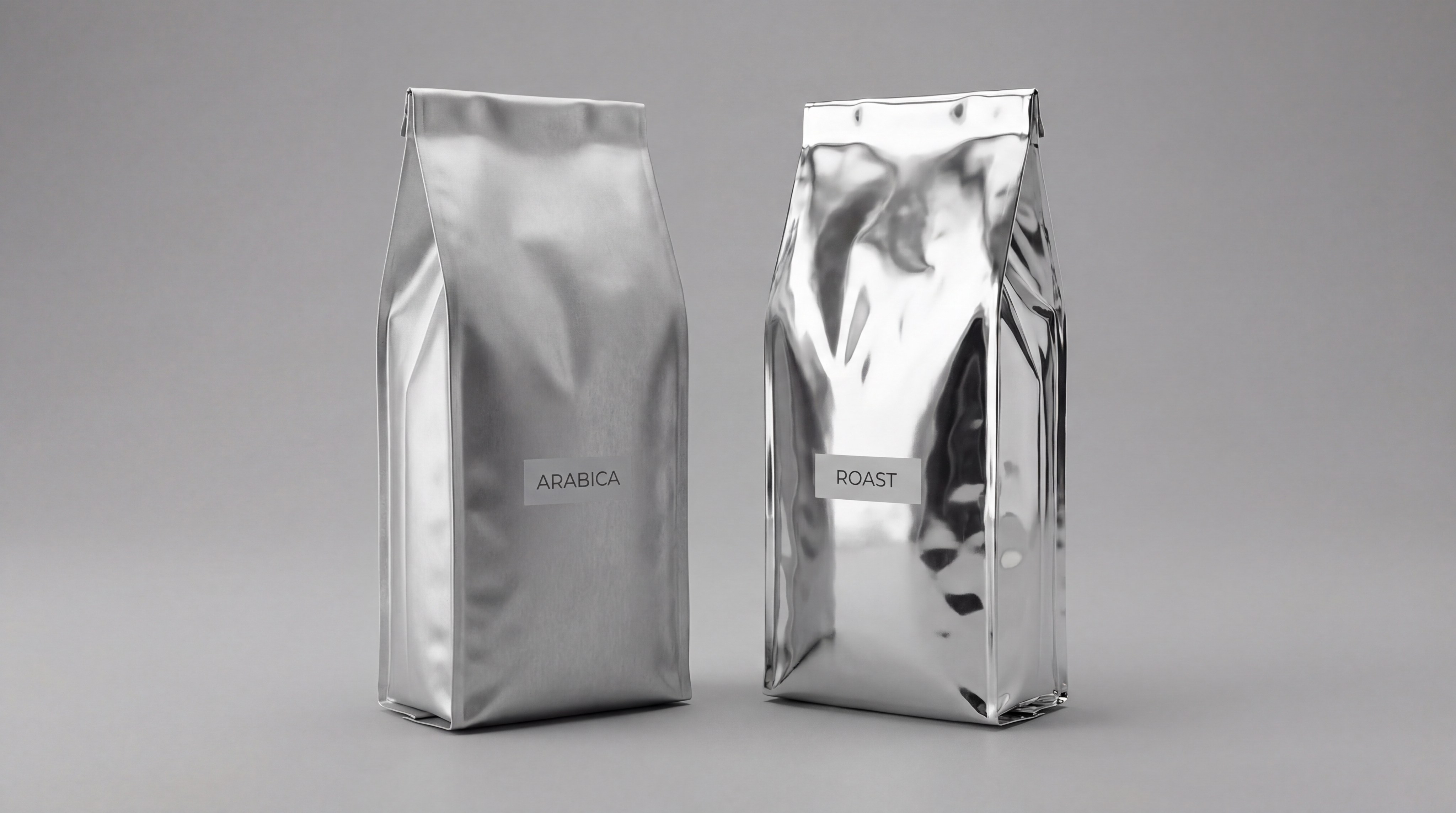
But here is the kicker: not all “silver” bags are actually aluminum. Many are just metallized plastic, which doesn’t perform nearly as well for long-term storage.
Key Takeaway: If your shelf life needs to exceed 12 months, aluminum foil is your only real choice.
How does the thickness of the foil impact the scent?
While standard foil layers are around 7 microns, thicker layers can offer even more durability against pinholes. Thick foil prevents mechanical damage during shipping from compromising the internal atmosphere.
You might think more is always better, but it’s about finding the balance between flexibility and barrier strength. Too thick, and the bag becomes difficult for machines to seal properly.
Key Takeaway: Match your foil thickness to your distribution channel to prevent barrier cracks.
Material
Oxygen Barrier (OTR)
Moisture Barrier (MVTR)
Aroma Protection
Aluminum Foil
0.00
0.00
Excellent
VMPET
0.5 – 2.0
0.1 – 1.1
Good
Standard PE
2000+
15.0
Poor
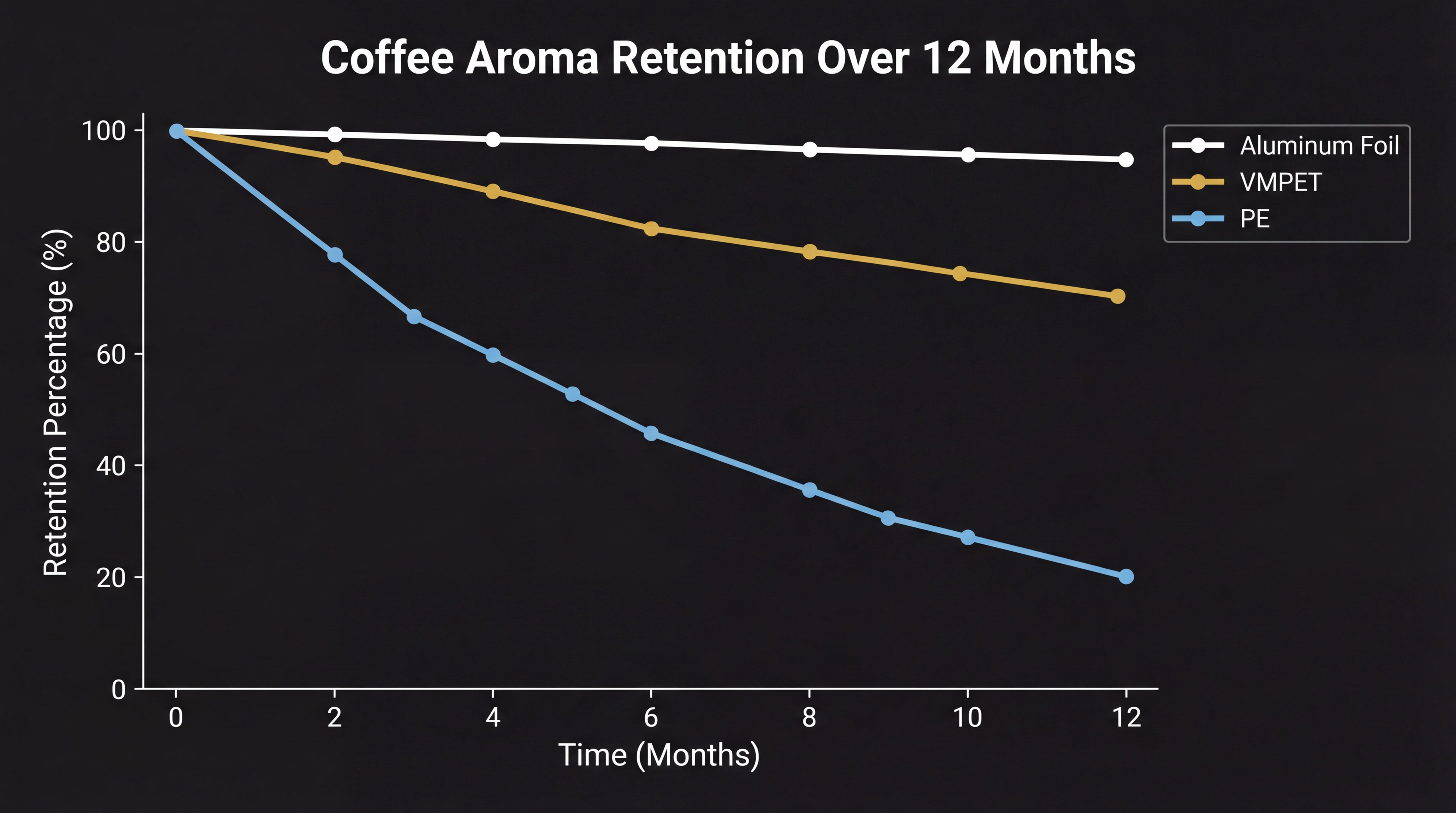
The data proves that nothing beats the physical barrier of solid aluminum for maintaining the integrity of delicate roasted notes.
Is VMPET a viable alternative for coffee aroma retention?
VMPET, or metallized polyester, offers a mid-range solution for coffee aroma retention that works well for fast-moving consumer goods. It provides a shiny aesthetic and decent protection without the higher cost of pure aluminum foil.
When should you choose VMPET over aluminum foil?
VMPET is ideal for coffee that will be consumed within 3 to 6 months of roasting. It is lighter and more flexible, making it easier to run on high-speed packaging lines.
Lower cost per square meter compared to solid aluminum foil.
Better environmental footprint during the manufacturing production process.
Higher resistance to “flex cracking” during long-distance transport.
Check this out: if you are a local roaster with high turnover, VMPET might actually be your best friend.
Key Takeaway: Use VMPET for high-volume, quick-turnover products to save on costs without sacrificing short-term quality.
Does VMPET lose its barrier over time?
Unlike solid foil, the microscopic metal layer on VMPET can have tiny gaps that allow slow gas exchange over many months. This doesn’t mean it’s bad, just that it has a specific “best before” date.
I’ve seen brands switch to VMPET and see no difference in customer satisfaction because their product moved so fast. It’s all about your specific supply chain speed and rotation.
Key Takeaway: Only use VMPET if you are certain your product won’t sit on a shelf for a year.
Feature
Aluminum Foil
VMPET
Cost
Higher
Lower
Flex Cracking
Vulnerable
Resistant
Long-term Barrier
100%
85-90%
VMPET is the pragmatic choice for efficiency, while foil is the choice for absolute perfection in flavor preservation.
How does the oxygen barrier level impact coffee aroma retention?
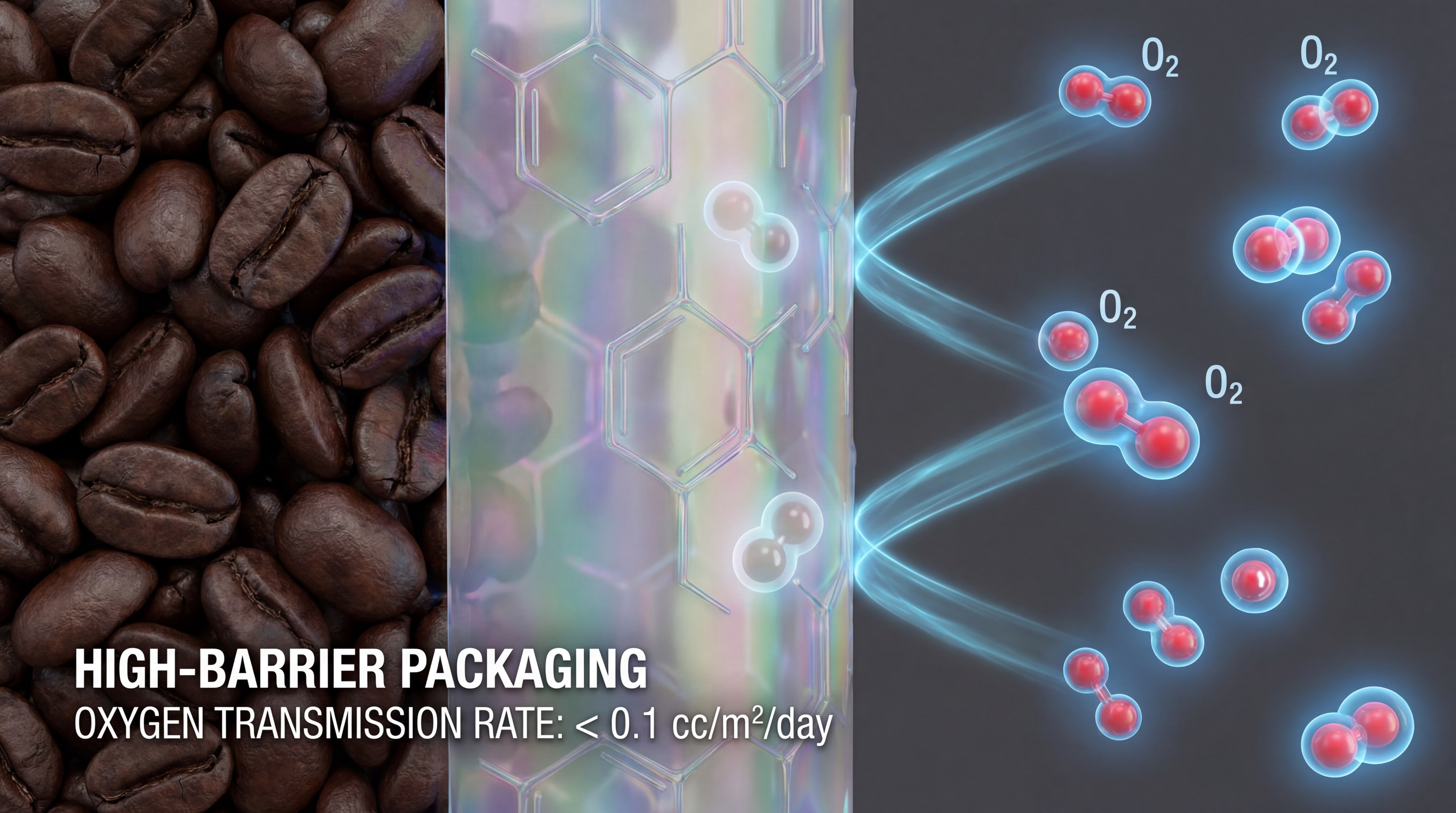
The oxygen barrier level is the primary metric that determines coffee aroma retention because oxygen is the enemy that oxidizes volatile oils. When oxygen enters the bag, it triggers a chemical reaction that turns fragrant oils into rancid-smelling compounds.
What is the relationship between oxygen and staleness?
Oxygen acts as a catalyst for degradation, stripping away the delicate top notes of the coffee’s scent profile. High-barrier films keep oxygen levels below 1% to ensure the “aroma trap” remains sealed.
Oxidation destroys delicate floral and citrus notes first.
High OTR materials lead to “flat” coffee within just days.
Nitrogen flushing only works if the film barrier is strong.
Think about it like this: your coffee is a living thing, and oxygen is what makes it age prematurely.
Key Takeaway: Prioritize materials with an OTR of less than 0.1 to keep your coffee “young” and fragrant.
Can you smell oxygen damage before you taste it?
Absolutely, as the first sign of oxidation is the loss of the “bloom” scent when hot water hits the grounds. If your packaging allows oxygen ingress, that magical morning ritual is completely ruined for your customer.
We at Newidea Pack often tell our clients that the bag is the “vault” for their roast. If the vault has a leak, the aromatic treasure disappears quickly.
Key Takeaway: Always test your film’s OTR rating before committing to a large-scale production run.
Barrier Level
OTR (cc/m2/day)
Recommended Use
Ultra High
< 0.1
Specialty Whole Bean
High
0.1 – 1.0
Ground Coffee
Medium
1.0 – 10.0
Short-term Retail
Low OTR ratings are the secret ingredient to ensuring that “freshly roasted” smell reaches the consumer’s home.
Why are multi-layer films required for coffee aroma retention?
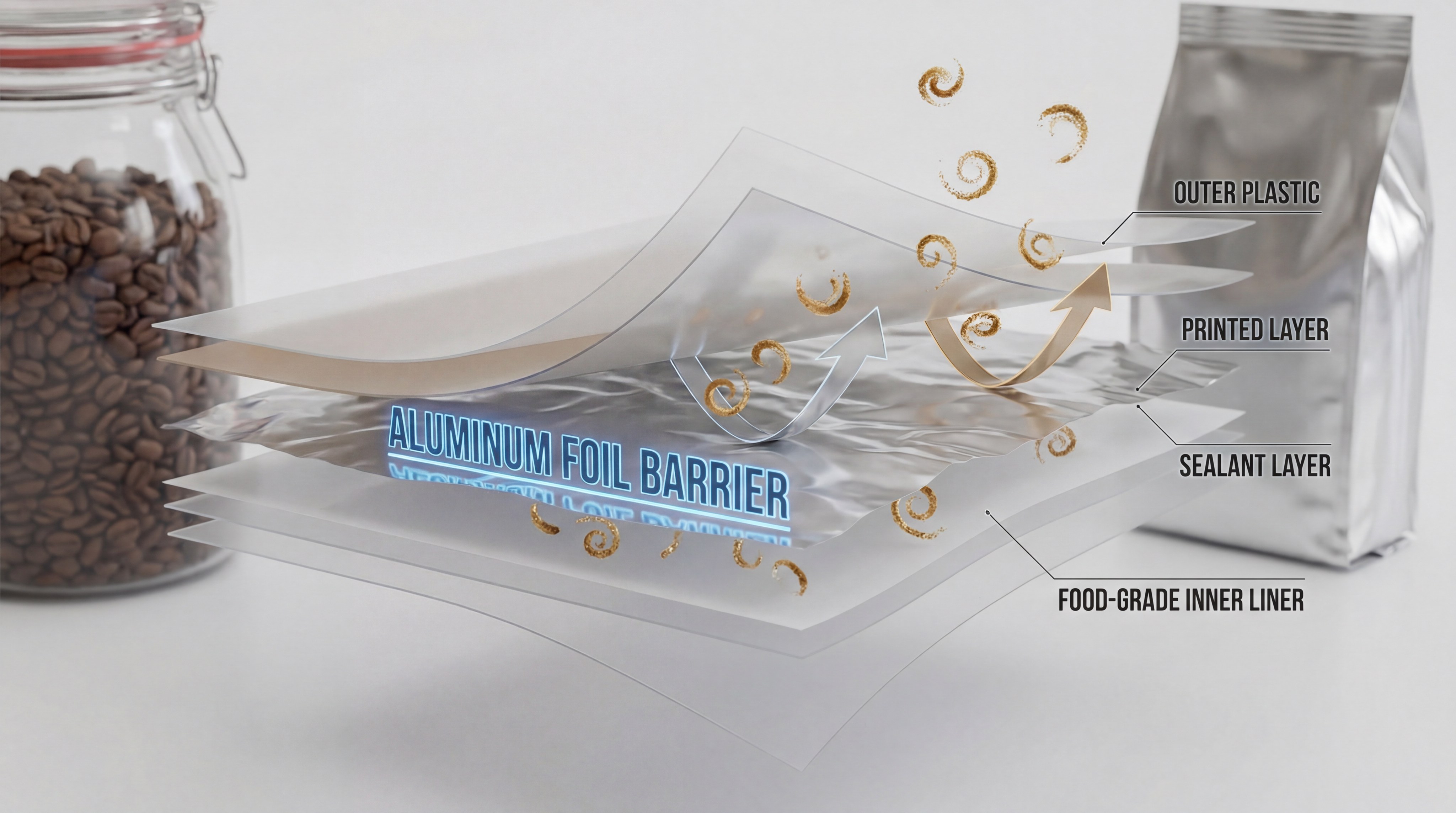
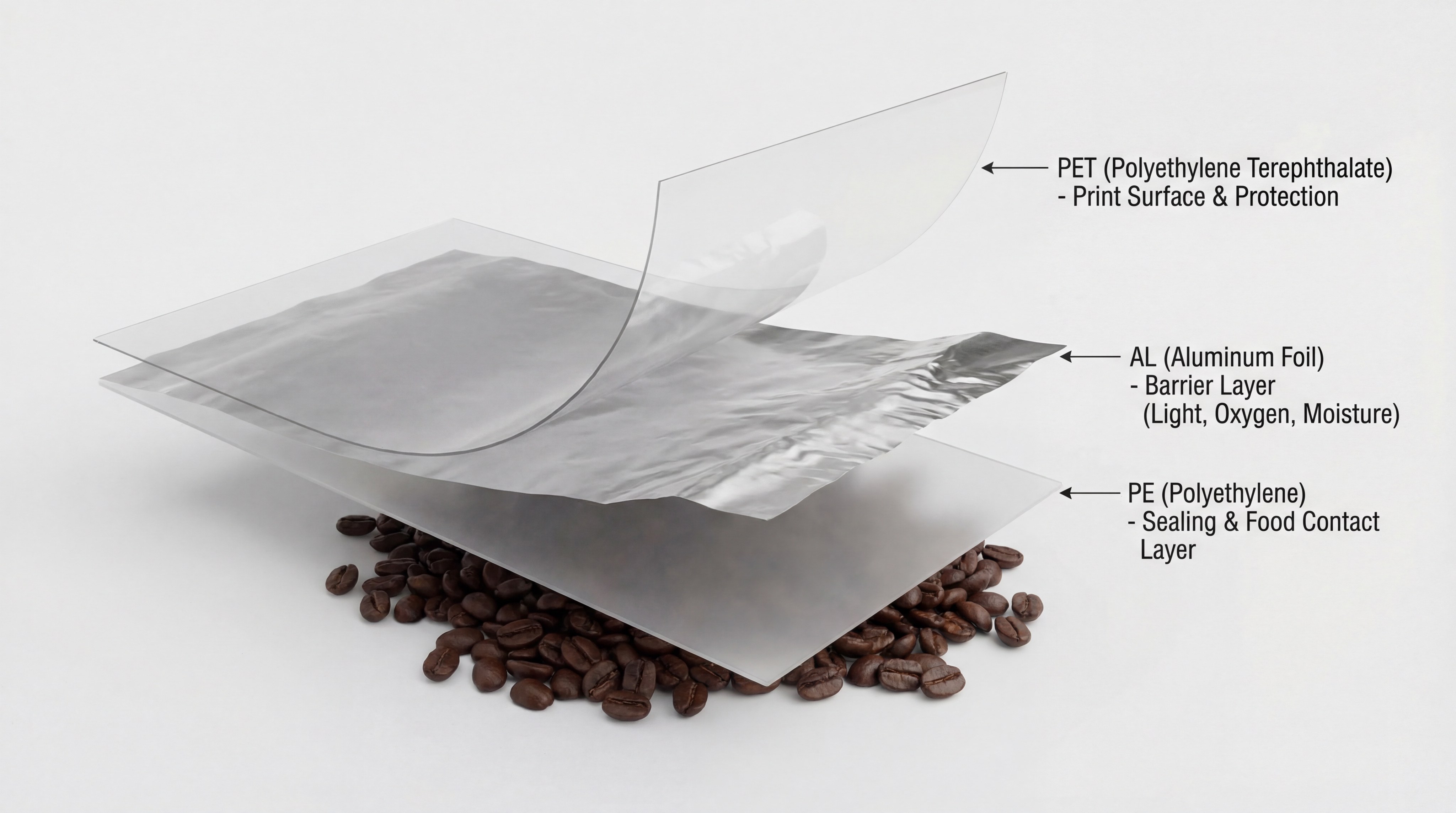
Multi-layer composite films combine the strengths of different materials to create the ultimate environment for coffee aroma retention. By sandwiching layers like PET, Aluminum, and PE, you create a synergistic barrier that no single material could achieve alone.
What is the ideal “recipe” for a coffee laminate?
A standard high-performance laminate usually consists of PET for printing, Aluminum for barrier, and PE for sealing. This “triple threat” ensures that every angle of aroma loss is covered effectively.
PET provides a high-quality surface for brand storytelling and graphics.
Foil acts as the impenetrable core barrier for the beans.
PE ensures the bag stays airtight through the rigors of shipping.
Does this sound complicated? It’s actually the industry standard for a reason—it simply works best.
Key Takeaway: Don’t settle for two layers; three layers are the minimum for true specialty coffee protection.
Can “green” materials offer the same scent protection?
New compostable and recyclable multi-layer films are emerging, but they often require specialized coatings. We are seeing huge strides in high-barrier mono-materials that are much easier to recycle.
I’ve tested some of these new “eco-friendly” films, and the best ones use EVOH coatings to mimic the foil barrier.
Key Takeaway: If going green, ensure your supplier provides OTR data for their sustainable laminates.
Layer Number
Material
Primary Function
Outer
PET / BOPP
Aesthetics & Durability
Middle
Foil / VMPET
Aroma & Oxygen Barrier
Inner
LLDPE
Hermetic Sealing
Each layer has a specific job in the “aroma defense squad,” working together to protect the beans.
What role does degassing valve integration play in coffee aroma retention?
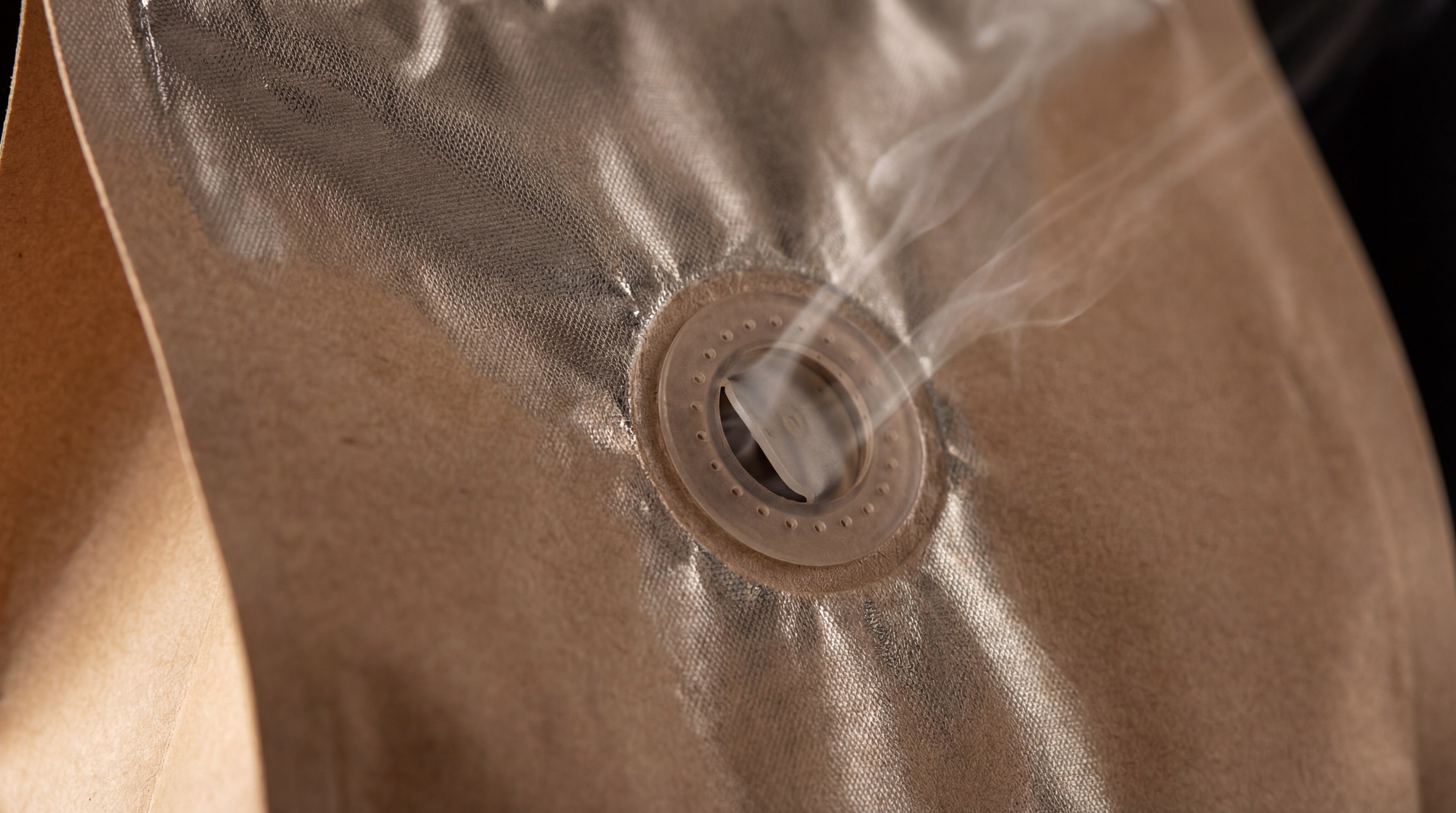
A one-way degassing valve is essential for coffee aroma retention because it allows CO2 to escape without letting oxygen in. Without this valve, the pressure from freshly roasted beans would either bloat the bag or force the use of porous materials.
How does CO2 management protect the aroma?
Freshly roasted coffee releases a significant amount of Carbon Dioxide, which can carry aromatic compounds away if it escapes too quickly. The valve acts as a pressure regulator, keeping the internal environment stable.
Prevents bag bursting or “ballooning” on the retail shelf.
Allows for “roast-to-ship” speed without waiting days for degassing.
Keeps the internal pressure slightly higher to prevent oxygen entry.
But here is the real secret: the valve also allows customers to “squeeze and sniff” without opening the bag.
Key Takeaway: The valve is a one-way street that keeps the good stuff in and the bad stuff out.
Is the placement of the valve important?
If the valve is placed too low, oils from the coffee can clog it, causing it to fail and ruin the barrier. Proper integration on the upper third of the bag ensures it stays clean and functional.
I always tell our partners at Newidea Pack that a clogged valve is worse than no valve at all. It turns your bag into a ticking time bomb of stale air.
Key Takeaway: Position your valve strategically to ensure long-term functionality and aroma protection.
Valve Feature
Benefit
Effect on Aroma
One-Way Flow
Blocks Oxygen
Prevents Oxidation
CO2 Release
Relieves Pressure
Maintains Bag Integrity
Filter Membrane
Blocks Dust/Oils
Keeps Valve Working
The valve is the “lungs” of your packaging, allowing it to breathe without losing its internal essence.
How does VFFS seal integrity influence coffee aroma retention?
Seal integrity is the “weakest link” in coffee aroma retention because a single pinhole leak can bypass the best barrier materials. Even if your film is perfect, a poor seal allows aromatic gases to diffuse out and oxygen to seep in.
How do you identify a “leaky” seal?
Leaky seals often happen at the “T-junctions” where the gussets meet the main seal on the bag. If these aren’t fused perfectly, you’ll lose that “fresh” smell before the bag even hits the retail shelf.
Check for “channel leakers” in the heat-seal area regularly.
Ensure consistent pressure across the sealing jaws of the machine.
Watch for “wrinkles” which create microscopic air tunnels for scent.
Think about it: a bag is only as good as its weakest point, which is almost always the seal.
Key Takeaway: Invest in high-quality sealing jaws and regular maintenance to prevent “ghost” leaks.
Does heat-seal temperature affect the aroma?
If the temperature is too high, you can actually melt through the barrier layer or create “stress cracks” in the foil. If it’s too low, the bond isn’t molecularly fused, leading to slow air exchange.
We at Newidea Pack spend hours calibrating the dwell time and temperature for our clients. It’s the “secret sauce” of great packaging.
Key Takeaway: Fine-tune your sealing parameters to find the “sweet spot” where the seal is stronger than the film.
Seal Issue
Cause
Impact on Aroma
Channel Leak
Poor Pressure
High (Immediate loss)
Burn-through
Excess Heat
Moderate (Pinhole risk)
Cold Seal
Insufficient Heat
High (Slow diffusion)
Perfect seals are the final barrier between your coffee and a stale death, ensuring the aroma remains trapped inside.
Can UV light protection improve your coffee aroma retention?
UV light protection is a critical secondary factor in coffee aroma retention because light energy can break down the complex molecules that make up coffee’s scent. Photo-oxidation is a silent killer that works even if your bag is perfectly airtight.
Why does light “skunk” your coffee?
Light energy, especially UV, provides the “spark” for chemical reactions that degrade fatty acids into smelly aldehydes. If you use clear packaging, your coffee’s aroma can degrade in just a few days under grocery store lights.
Clear bags are fine for “roast-dated” shops but bad for long-term retail.
Dark-colored inks provide some protection, but not total blockage.
Foil layers provide 100% light blockage, the ultimate defense against UV.
You wouldn’t leave a fine wine in a clear bottle in the sun, so why do it to your coffee?
Key Takeaway: Use opaque materials to prevent light-induced flavor and scent degradation.
Can you have a “window” without losing the scent?
If you must have a window to show the beans, ensure it is treated with a UV-blocking coating. However, keep in mind that any clear area is a compromise on the absolute maximum shelf life.
I’ve seen some brilliant designs that use a “flip-up” label to reveal a window, keeping the beans dark until the customer looks.
Key Takeaway: Keep windows small and away from direct sunlight to minimize “aroma burn.”
Packaging Type
Light Protection
Best For
Foil Laminate
100%
Premium Retail
VMPET
95-98%
Standard Retail
Clear PE
0%
In-store/Immediate Use
Light is an invisible thief; do not let it steal your product’s soul while it sits on the shelf.
How should roasters test for effective coffee aroma retention?
The best way to monitor coffee aroma retention is through a combination of sensory cupping and scientific gas analysis. By tracking the quality of your beans over 3, 6, and 12 months, you can prove whether your packaging is actually doing its job.
Should you perform a “Squeeze Test” regularly?
The squeeze test is a simple, low-tech way to check if your valve and seals are working properly. If you squeeze a bag and can’t smell anything through the seams (only the valve), your seal integrity is likely high.
Check for “bloated” bags which indicate a valve failure.
Perform “submersion tests” to look for air bubbles in the seals.
Conduct blind cuppings of old vs. new stock to track scent loss.
But here’s the kicker: your nose is actually a more sensitive instrument than many lab machines for specific “off” notes.
Key Takeaway: Incorporate “aroma checks” into your weekly QA routine to catch batch issues early.
Is professional lab testing worth the cost?
For large-scale brands, sending samples to a lab to measure “headspace oxygen” is the only way to be 100% sure. This data allows you to confidently put a “best by” date on your product that actually means something.
I’ve worked with brands that saved thousands by realizing they were over-packaging for a product that had a 2-week turnover.
Key Takeaway: Use data to optimize your material costs—don’t pay for more barrier than you actually need.
Test Method
Cost
Accuracy
Ease of Use
Sensory Cupping
Low
Medium
High
Bubble Test
Very Low
Low
Very High
Gas Chromatography
High
Very High
Low
A mix of “gut feeling” and “hard science” is the best recipe for maintaining perfect packaging standards.
How does the final brew prove successful coffee aroma retention?
The moment of truth for coffee aroma retention happens in the consumer’s kitchen when the bag is first opened. If the air fills with that rich, roasted perfume, your packaging has successfully completed its mission.
What is the “Bloom Test” for packaging?
When hot water hits the grounds, they should “bloom” and release a vibrant, complex fragrance profile. If the coffee is flat or smells like cardboard during the brew, the packaging failed to protect the volatile oils.
Freshly protected beans release a strong CO2 bloom.
The scent should match the tasting notes on the bag perfectly.
The aroma should linger in the room long after brewing.
Think about it: the brew is the final performance of all your hard work as a roaster.
Key Takeaway: The consumer’s sensory satisfaction is the only metric that truly builds long-term brand loyalty.
Does ground coffee require even better barriers?
Ground coffee has exponentially more surface area exposed, making it much more vulnerable to aroma loss than whole beans. For ground products, a high-barrier aluminum foil layer is almost always non-negotiable for retail.
I’ve seen ground coffee lose its soul in a week when stored in poor-quality VMPET bags.
Key Takeaway: Be even more strict with material specs when packaging pre-ground coffee products.
Form
Aroma Surface Area
Vulnerability
Recommended Barrier
Whole Bean
Low
Medium
VMPET / Foil
Coarse Ground
High
High
Aluminum Foil
Fine Ground
Very High
Ultra High
Aluminum Foil
Your material choice determines whether the customer’s morning ritual is a delight or a disappointment.
Conclusion
Protecting the aromatic soul of your coffee is both an art and a science. By understanding the interplay between aluminum foil barriers, oxygen transmission rates, and seal integrity, you can ensure that your customers experience the full depth of your roast every time they open a bag. At Newidea Pack, we are dedicated to helping roasters bridge the gap between great coffee and great packaging through our advanced machinery and material expertise. Our commitment to freshness means providing solutions that act as a permanent vault for your beans’ volatile oils.
FAQ
Can I use paper bags for long-term coffee aroma retention? No, you cannot use plain paper because it is naturally porous and offers zero barrier against oxygen or moisture. While they look “natural,” paper bags will lead to stale coffee within days unless they have a hidden high-barrier plastic or foil liner inside.
What’s the best way to tell if my packaging is leaking scent? Perform a simple “pressure test” by gently squeezing the bag while it’s submerged in water. If you see bubbles coming from the seals or seams rather than the valve, your aroma is escaping through a faulty mechanical seal.
How do I know if I need a 3-layer or 2-layer film? It depends on your shelf-life goals; if you need the coffee to stay fresh for more than 3 months, you almost certainly need a 3-layer film with a dedicated barrier like aluminum foil.
Can I recycle coffee bags that have aluminum foil? Usually no, because the layers are bonded together and difficult to separate in standard recycling facilities. However, you can switch to modern mono-material PE films that offer high barriers and are widely recyclable in many regions.
What is the best material for eco-friendly coffee aroma retention? High-barrier mono-material PE or compostable films with an EVOH coating are currently the best options for sustainability. They provide a respectable oxygen barrier while being much kinder to the environment than traditional foil laminates.
Sales Pitch Component
Ready to achieve the <1% oxygen benchmark and scale your roasting business?
Contact us today to find the perfect packaging fit for your needs.