What Proven Checkpoints Make Your Coffee Packaging QC A Success
2026年1月18日 by newideapack
Mastering coffee packaging QC (Quality Control) is the difference between a premium brew and a stale disappointment. To achieve a successful production line, you need a rigorous 7-step quality control protocol that integrates automated weight precision, advanced seal integrity testing, and nitrogen residual analysis. Imagine the frustration when a batch of specialty roasted beans reaches a client, only for them to find the aroma has vanished due to a faulty valve or a microscopic leak. By implementing these proven checkpoints for your coffee packaging QC, you protect your brand reputation and eliminate the financial losses caused by wasted materials and returns.
Why is seal integrity vital for compostable coffee packaging?
Seal integrity is the primary barrier that prevents oxygen ingress and moisture absorption, which is especially critical for maintaining the structural stability of compostable coffee packaging. Because sustainable materials often have different melting points than traditional plastics, NewIdeaPack emphasizes that a precise seal integrity test is the only way to verify that your barrier remains airtight.
Can vacuum testing detect microscopic leaks?
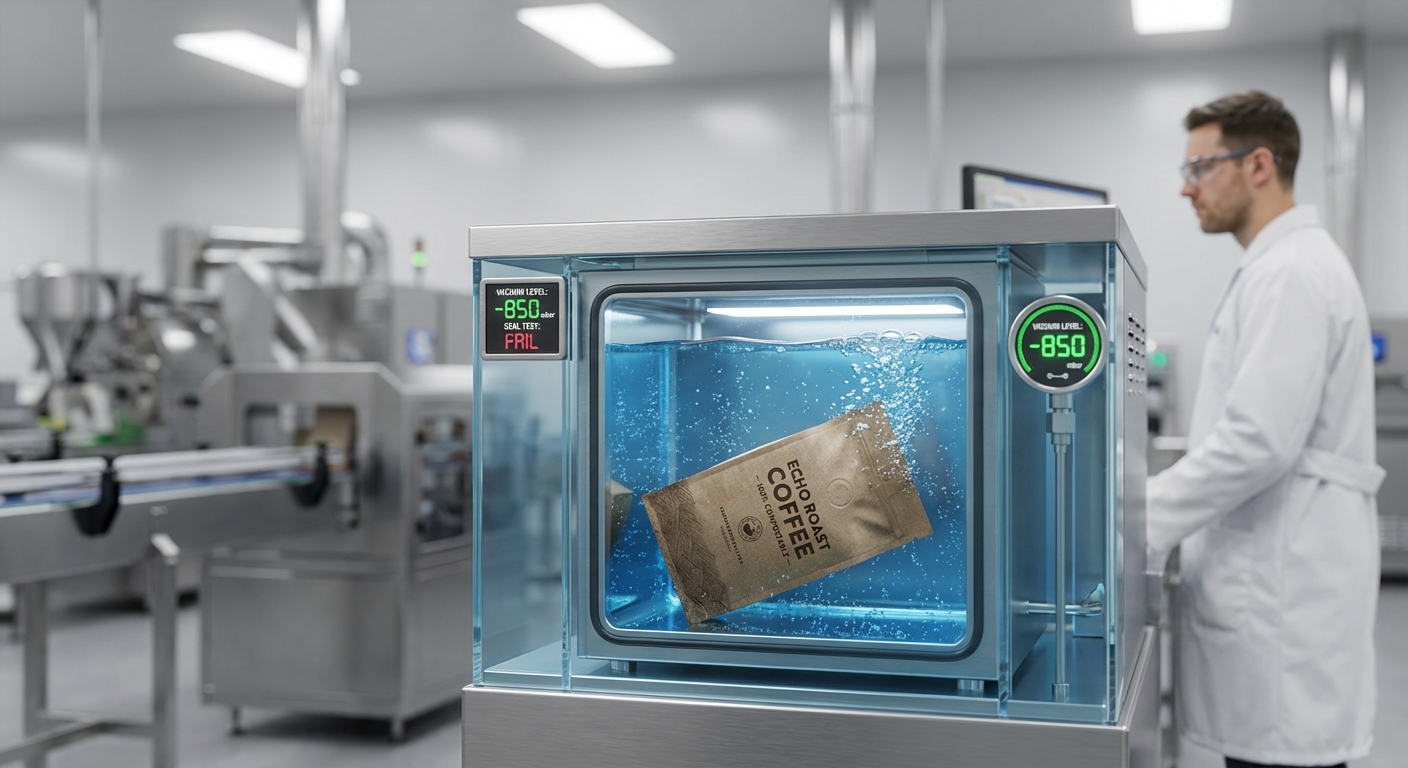
Vacuum decay testing provides a non-destructive way to ensure your pouches won’t fail during transit or long-term storage. You see, even a pinhole-sized gap can ruin an entire batch of specialty coffee.
Non-destructive testing preserves the product for sale.
Digital sensors detect pressure changes as small as 0.1 mbar.
Automated systems provide immediate pass/fail results on the line.
The truth is, manual “squeeze tests” are no longer sufficient for modern industrial standards.
How does heat distribution affect seal strength?
Uniform heat distribution across the sealing jaws ensures that the bio-based polymers in eco-friendly films fuse correctly without burning or thinning. If the temperature fluctuates by even a few degrees, you risk creating “weak spots” that burst under the pressure of degassing.
PID temperature controllers maintain ±1°C accuracy.
Serrated jaw patterns increase the surface area of the bond.
Dwell time must be calibrated to the specific thickness of the film.
Here is the best part: advanced machines now log every seal’s temperature data for 100% batch traceability.
Key Takeaway: Implementing a standardized seal integrity test routine prevents oxidation and extends the shelf life of your specialty roasts by ensuring the barrier remains 100% airtight.
QC Parameter
Target Metric
Frequency
Tool Used
Seal Strength
> 15N/15mm
Every 2 Hours
Tensile Tester
Leak Rate
0% at 500mbar
Every Batch
Vacuum Chamber
Heat Accuracy
±1°C
Continuous
PID Controller
The data proves that consistent thermal monitoring reduces scrap rates by up to 15% when using sensitive eco-materials.
Does weight precision impact compostable coffee packaging?
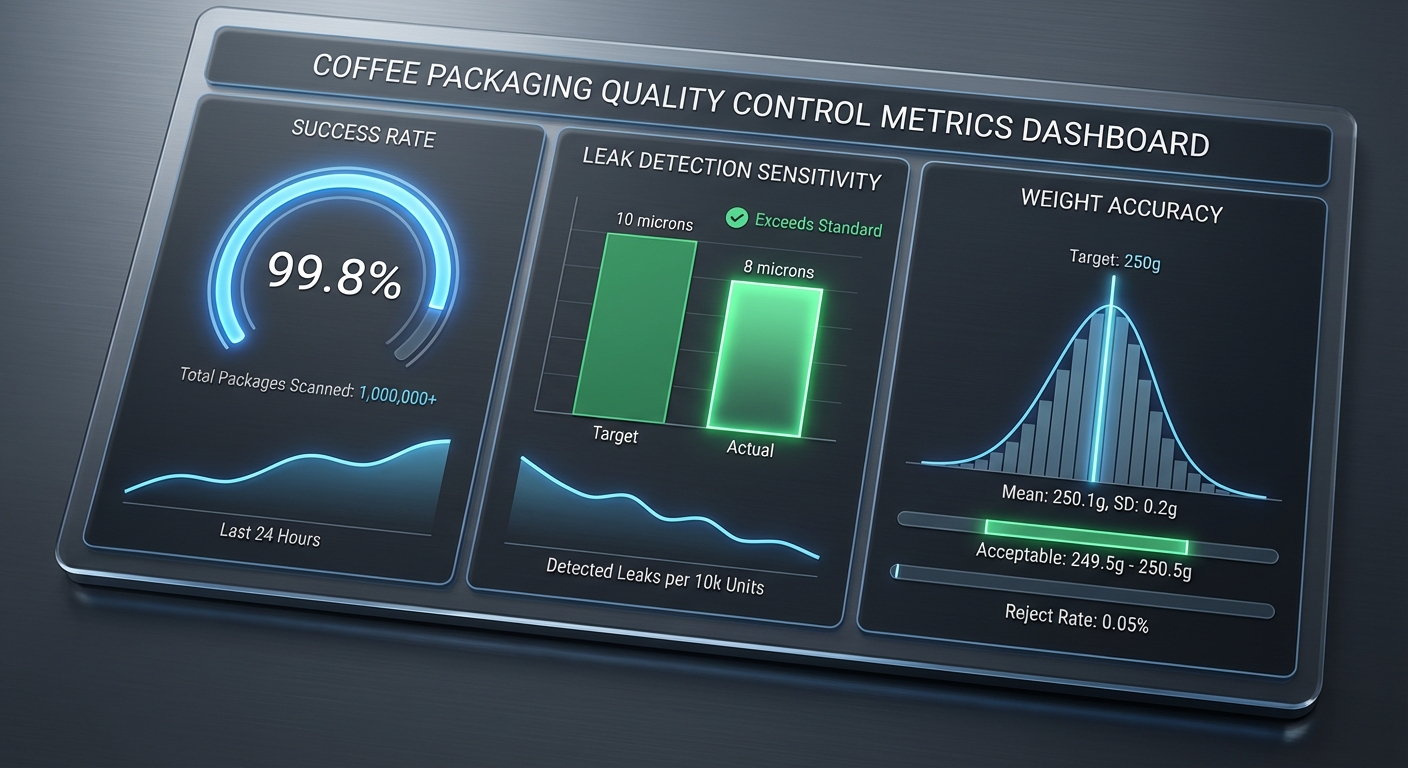
Achieving extreme weight precision is essential for compostable coffee packaging because it ensures regulatory compliance while preventing “product give-away” that eats into your profit margins. NewIdeaPack machines utilize high-sensitivity load cells to ensure that every pouch, whether it contains 250g or 1kg, stays within a fraction of a gram of the target weight.
Is multi-head weighing better for whole beans?
Multi-head weighers are the gold standard for whole bean packaging because they use complex algorithms to combine different buckets for the most accurate total weight. Think about it: whole beans vary in density and size, making volume-based filling inherently unreliable.
Combination weighing reduces deviation to less than 0.5g per bag.
High-speed actuators allow for up to 100 discharges per minute.
Vibratory feeders ensure a steady flow of product without breakage.
But wait, there’s more to it than just speed.
How do you handle fine coffee powder drift?
Fine grinds can create dust clouds that interfere with the weighing mechanism or settle in the seal area, compromising the package’s integrity. You must use enclosed auger fillers with dust extraction systems to keep the environment clean and the weight measurements stable.
Auger revolutions are controlled by high-precision servo motors.
Enclosed hoppers prevent environmental moisture from affecting powder weight.
Feedback loops from check-weighers automatically adjust the filler.
It gets even better when you integrate a reject arm to remove any out-of-spec bags instantly.
Key Takeaway: High-precision weighing systems protect your brand from legal issues regarding under-filling while maximizing your ROI by minimizing wasted product.
Component
Function
Precision Level
Benefit
Load Cell
Measures mass
±0.1g to ±0.5g
Regulatory compliance
Auger Servo
Controls volume
±0.2%
Consistent dosing
Check-weigher
Final verification
100% inspection
Zero defect shipping
Integrating a real-time feedback loop between the weigher and filler can improve your overall equipment effectiveness (OEE) by nearly 20%.
Is nitrogen testing key for compostable coffee packaging?
Rigorous nitrogen residual testing is the only way to confirm that your compostable coffee packaging effectively maintains an inert atmosphere to prevent the staling of delicate coffee oils. By using the drip bag ultrasonic packaging machine from NewIdeaPack, you can achieve residual oxygen levels below 1%, which is the industry benchmark for long-term freshness.
Why does oxygen kill coffee flavor so fast?
Oxygen triggers lipid oxidation, which turns the flavorful oils in coffee rancid and destroys the aromatic compounds you worked so hard to roast. Believe it or not, coffee starts losing its peak flavor within minutes of exposure to air.
Residual oxygen levels should ideally be below 0.5%.
Nitrogen flushing displaces the air before the final seal is applied.
Aroma preservation is directly correlated to the lack of O2.
The bottom line is this: without a low-oxygen environment, your coffee’s shelf life drops from months to weeks.
How do you perform a nitrogen residual test?
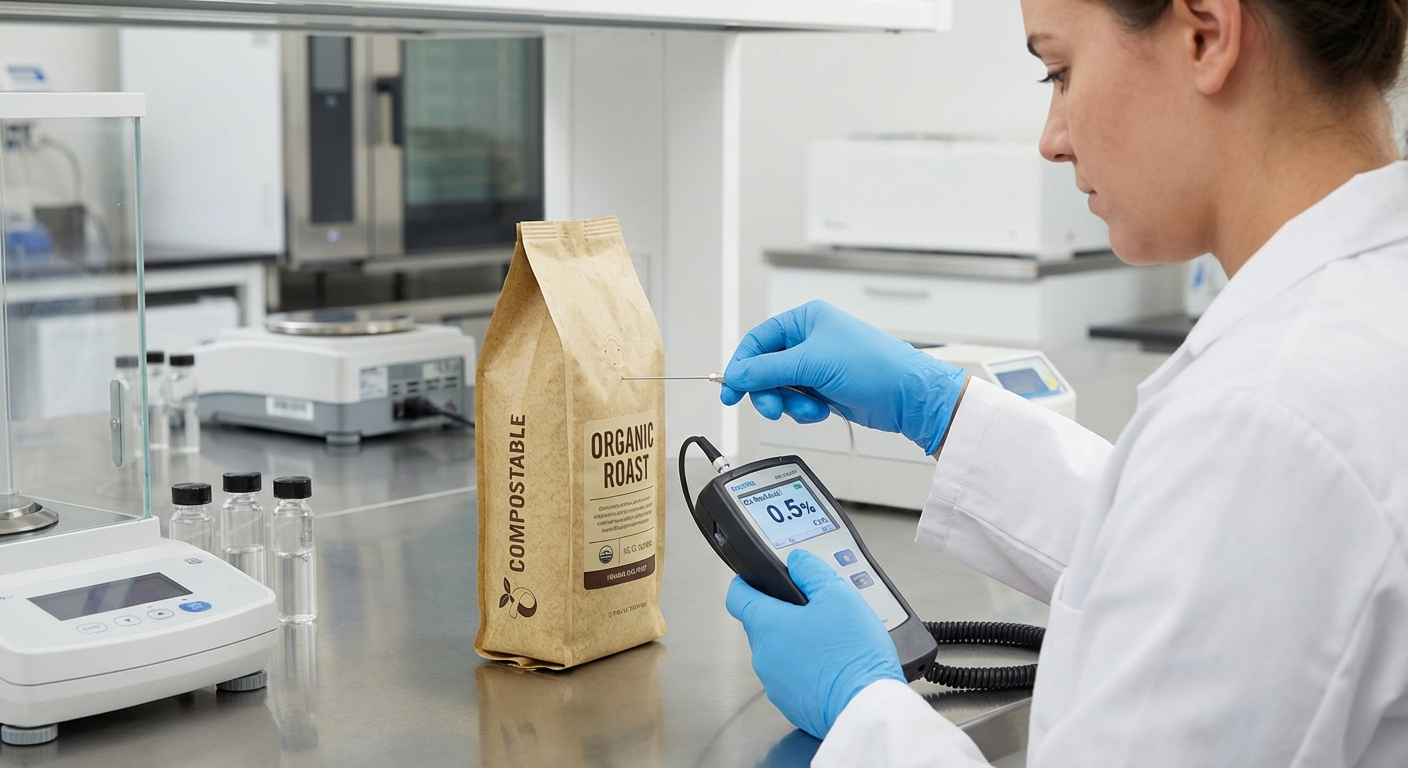
Testing involves using a handheld or benchtop oxygen analyzer with a needle probe to sample the gas inside a finished pouch. You simply pierce the bag through a septum to measure the internal atmosphere without allowing outside air to enter.
Electrochemical sensors provide readings in seconds.
Tests should be performed at the start, middle, and end of every shift.
Data logging helps identify if the nitrogen supply is dwindling.
And the best part? Modern systems can automate this sampling directly on the packaging line.
Key Takeaway: Regular nitrogen residual testing ensures that your Modified Atmosphere Packaging (MAP) is functioning correctly, guaranteeing that customers experience the “just-roasted” smell every time they open a bag.
Testing Metric
Standard Goal
Critical Limit
Corrective Action
Oxygen Level
< 1.0%
> 2.0%
Adjust gas flow
Gas Pressure
0.2 – 0.5 Bar
< 0.1 Bar
Check supply tank
Flush Time
0.5 – 1.0s
< 0.4s
Recalibrate PLC
Consistent monitoring of gas levels is the most cost-effective way to double the shelf life of your premium coffee products.
How do valves function in compostable coffee packaging?
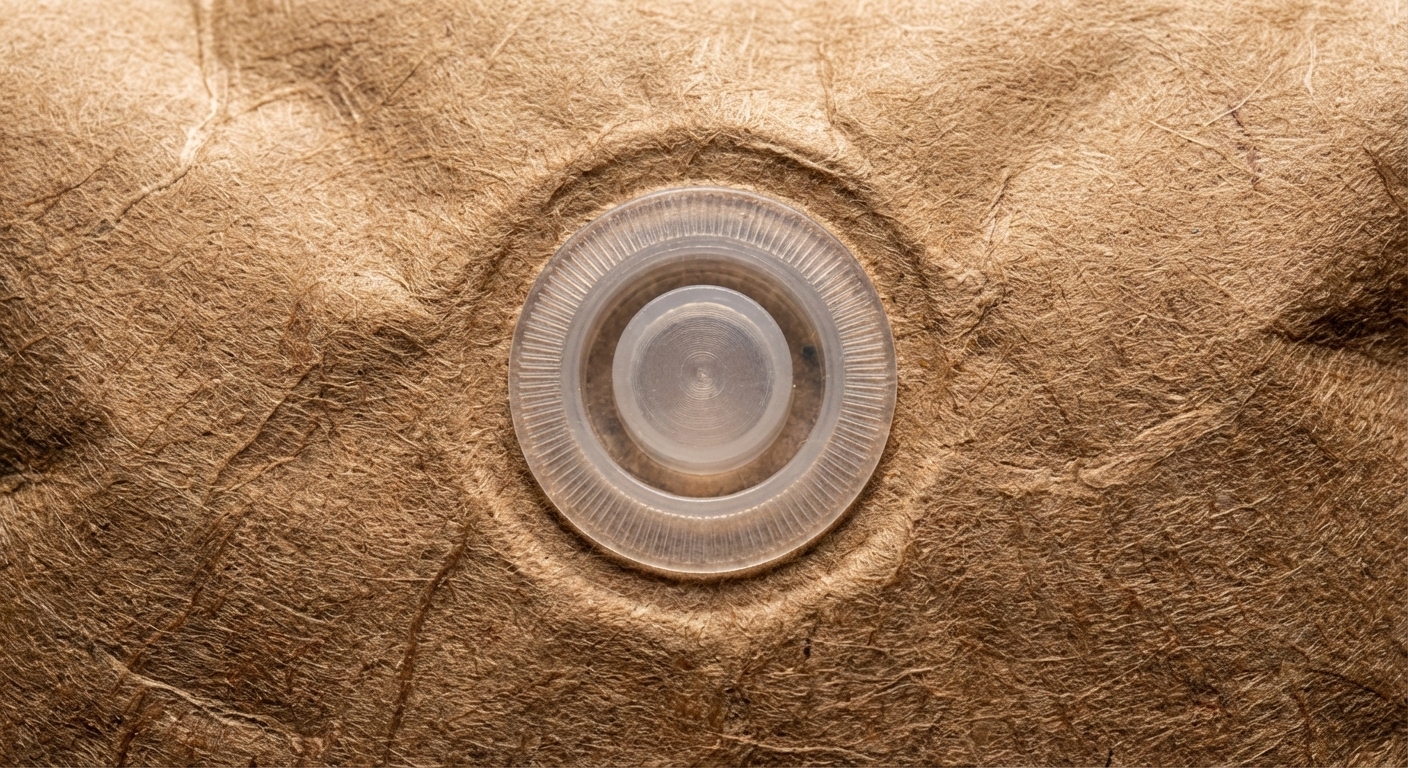
One-way degassing valves are essential for compostable coffee packaging because they allow carbon dioxide to escape without letting oxygen in, preventing the bag from bloating or bursting. For sustainable materials, NewIdeaPack recommends using bio-valves that share the same compostability certifications as the film to maintain the package’s “green” integrity.
Why is CO2 release a problem for sealed bags?
Freshly roasted coffee releases a significant amount of CO2, which can create enough internal pressure to pop the seams of a sealed bag if it has nowhere to go. You have probably seen “ballooned” bags on grocery shelves; these are usually the result of faulty or missing valves.
Valves allow degassing immediately after roasting and packing.
The one-way mechanism prevents the entry of external contaminants.
Internal pressure is kept at a safe level for stacking and transport.
Think of it as a professional “breathing” system for your beans.
How do you verify valve functionality on the line?
You should perform a pressure test to ensure the valve opens at the correct PSI and seals tightly once the excess gas is released. If the valve is stuck open, your nitrogen flush is wasted; if it is stuck closed, the bag will inevitably fail.
Visual inspection ensures the valve is centered and correctly fused.
Manual pressure tests verify the “click” of the one-way diaphragm.
Ultrasonic valve application prevents heat damage to the valve filter.
The real secret is choosing a valve with a high-quality filter to prevent coffee dust from clogging the mechanism.
Key Takeaway: Quality valves are the unsung heroes of coffee packaging, balancing internal pressure while serving as the final gatekeeper against oxygen-induced staling.
Valve Feature
Quality Check
Requirement
Failure Impact
Opening Pressure
Pressure Gauge
0.05 – 0.1 PSI
Bag bloating
Seal Integrity
Visual/Leak Test
No bypass air
Oxygen ingress
Material Match
Certification
Compostable
Waste stream contamination
Properly functioning valves are the difference between a premium product and a shelf-distorted failure that consumers will avoid.
Does speed affect QC for compostable coffee packaging?
Operating at high speeds can compromise the quality of compostable coffee packaging if the machine’s quality management systems are not synchronized with the increased throughput. NewIdeaPack designs equipment that maintains a high “First Pass Yield” even when pushing 100 bags per minute, ensuring that speed never comes at the cost of precision.
Can sensors keep up with 100 bags per minute?
High-speed production requires fiber-optic sensors and ultra-fast PLC processing to detect errors like misaligned film or empty pouches in real-time. If your sensors are sluggish, you might produce hundreds of defective bags before the machine finally shuts down.
Response times must be in the millisecond range.
Auto-tracking systems adjust film position without stopping the line.
Reject stations must be physically capable of removing bags at high velocity.
Ready for the kicker? Intelligent systems now predict failures before they happen by analyzing vibration patterns.
How does dwell time change at higher speeds?
As you increase speed, the “dwell time”—the amount of time the sealing jaws are in contact with the film—decreases, which often requires a higher temperature to achieve the same seal strength. For sensitive compostable materials, this is a delicate balance because too much heat will melt the outer layers of the film.
Ultrasonic sealing is often preferred for high-speed eco-packaging.
Servo-driven jaws allow for precise control over pressure and time.
Cooling stations help set the seal quickly after the heat is applied.
The reality is that consistency is much harder to maintain at high speeds without high-end automation.
Key Takeaway: High-speed production is only profitable if your QC systems are fast enough to catch errors instantly, preventing massive amounts of wasted material and product.
Speed (BPM)
Potential Risk
QC Solution
Impact
40 – 60
Low
Standard Sensors
Stable Quality
60 – 80
Medium
High-Speed PLC
Maintains Precision
80 – 100+
High
Vision Systems / AI
Zero Defect Target
Increasing your speed by 20% without upgrading your QC sensors can lead to a 5% increase in total waste, negating the efficiency gains.
Can ultrasonic tech fix compostable coffee packaging leaks?
Ultrasonic sealing technology is a game-changer for compostable coffee packaging because it creates a bond using high-frequency vibrations rather than external heat, which prevents the “thinning” often seen with traditional heat sealers. This cold-sealing method is particularly effective at sealing through coffee dust or oils that might be trapped in the seal area.
Why is ultrasonic sealing better for eco-films?
Eco-friendly films, such as those made from PLA or paper-based laminates, are often more heat-sensitive and have a narrower sealing window than traditional plastics. Ultrasonic energy targets only the interface between the films, leaving the outer layers of your beautiful compostable pouch undamaged.
Vibrations “shake” contaminants like coffee dust out of the seal zone.
Energy consumption is reduced by up to 75% compared to heat sealing.
The resulting seal is often stronger than the surrounding material.
Now, that’s what I call a “clean” solution for a green product.
Does it eliminate the risk of leakers?
While no technology is 100% foolproof, ultrasonic sealing drastically reduces the occurrence of “leakers” because it provides a molecular bond that is less susceptible to micro-cracks. You can actually see the difference under a microscope; the seal is uniform and lacks the brittle edges common with over-heated pouches.
Digital generators monitor the energy output for every single seal.
Instantaneous cooling means the seal reaches full strength immediately.
The process is highly repeatable with very low maintenance requirements.
Believe it or not, this tech pays for itself through reduced scrap rates alone.
Key Takeaway: Switching to ultrasonic sealing is the most effective way to ensure 99.9% seal integrity when working with the challenging physics of compostable and bio-based materials.
Feature
Heat Sealing
Ultrasonic Sealing
Winner for QC
Energy Source
Thermal Conduction
High-Frequency Vibration
Ultrasonic
Contaminant Handling
Poor (seals around dust)
Excellent (vibrates dust away)
Ultrasonic
Material Impact
Risk of melting/thinning
Cold process (safe)
Ultrasonic
Data from NewIdeaPack clients shows that ultrasonic systems reduce seal-related returns by over 60% compared to traditional thermal methods.
Is traceability needed for compostable coffee packaging?
Batch traceability is a non-negotiable component of compostable coffee packaging QC because it allows you to track every bag back to the specific time, machine, and raw material lot in the event of a quality issue. NewIdeaPack integrates coffee packaging machines with advanced inkjet or laser coding systems to ensure every package carries a unique, legible identity.
Why is a simple “Best By” date not enough?
A date code tells the consumer when to use the product, but a batch code tells the producer exactly what went wrong if a customer complains about stale coffee. Without deep traceability, you might have to recall an entire month’s worth of product instead of just a single afternoon’s production run.
Codes should include the production line and shift identifier.
Link codes to the specific oxygen and weight test results of that hour.
Laser coding is ideal for compostable films as it uses no ink.
But wait, there’s an even bigger advantage for your marketing team.
How do QR codes enhance the QC story?
Including a QR code on your compostable pouch allows consumers to scan and see the “journey” of their coffee, from the farm to the roasting date. This level of transparency builds incredible trust and proves that your quality control isn’t just a claim—it’s a documented reality.
Dynamic QR codes can link to specific batch lab results.
Customers can verify the compostability certifications of the film.
It provides a direct channel for feedback if quality isn’t perfect.
It’s the ultimate way to turn a technical requirement into a brand-building asset.
Key Takeaway: Robust traceability systems minimize the financial impact of quality failures and provide the data transparency that modern coffee consumers demand.
Coding Type
Best For
Pros
Cons
Inkjet
Standard pouches
High contrast, cheap
Ink can smudge
Laser
Eco-materials
Permanent, no chemicals
Higher initial cost
Thermal Transfer
Labels/Smooth film
High resolution
Requires ribbon
Implementing a 1-to-1 traceability link between your QC logs and your package codes can reduce recall costs by up to 90%.
What material tests suit compostable coffee packaging?
Before a single bean is packed, you must perform rigorous material testing on your compostable coffee packaging to ensure its barrier properties—specifically Oxygen Transmission Rate (OTR) and Water Vapor Transmission Rate (WVTR)—meet your coffee’s shelf-life requirements. NewIdeaPack works closely with film suppliers to verify that these “green” materials perform just as well as their plastic counterparts.
How do you measure OTR for bio-films?
OTR testing measures how much oxygen can permeate through a specific thickness of film over 24 hours. Because compostable materials are naturally more porous, you may need a multi-layer laminate with a high-barrier PLA or cellulose layer to achieve a zero-defect result.
Target OTR should be less than 0.1 cc/m²/day for specialty coffee.
Testing must be done at varying humidity levels to simulate real shipping.
Film thickness must be uniform across the entire roll.
The bottom line is simple: if the film is “leaky” on a molecular level, no amount of nitrogen flushing will save your coffee.
Does moisture affect the shelf life of eco-bags?
Yes, because many compostable materials are hygroscopic, meaning they can absorb moisture from the air if the barrier is insufficient. High moisture levels inside the bag lead to mold growth and a complete loss of the coffee’s “crisp” flavor profile.
WVTR testing ensures the “crunch” of the bean is preserved.
Laminating with metallized layers can drastically improve moisture barriers.
Material testing should include “flex-crack” resistance for shipping.
Think of it as choosing the right “armor” for your beans’ journey to the customer.
Key Takeaway: Never assume all compostable films are equal; verified lab data on OTR and WVTR is the only way to guarantee your coffee stays fresh for 6-12 months.
Material Property
Target Value
Impact of Failure
OTR (Oxygen)
< 0.5 cc/m²
Stale aroma, rancid oils
WVTR (Moisture)
< 0.5 g/m²
Soft beans, mold risk
Tensile Strength
> 30 MPa
Bag breakage during transit
Investing in high-barrier compostable laminates can extend your product’s “freshness window” by up to 300% compared to single-layer bio-plastics.
How to calibrate for compostable coffee packaging?
Machine calibration for compostable coffee packaging must be performed daily because these materials are highly sensitive to changes in ambient temperature and humidity. NewIdeaPack machines feature “recipe-based” settings that allow you to switch between different film types with the touch of a button, but manual verification of the sensors is still a critical QC step.
Why does “zeroing” your scales matter?
Even the best multi-head weigher can drift over time due to dust buildup or mechanical vibration, leading to inaccurate weight readings. You should use certified “check weights” at the start of every shift to ensure your load cells are reading accurately down to the milligram.
Zeroing removes the weight of the bucket (“tare”) from the calculation.
Calibration weights should be traceable to national standards.
Automatic calibration cycles can be programmed into the machine software.
You’ll be surprised how much product you can save just by calibrating once a day.
How do you calibrate nitrogen flow meters?
If your nitrogen flow meter is miscalibrated, you might be using too much gas (wasting money) or too little (risking oxidation). You need to use a calibrated gas analyzer to correlate the flow meter’s digital reading with the actual residual oxygen found inside the finished bags.
Pressure regulators must be checked for “creep” or leaks.
Flow rates should be adjusted based on the bag volume and speed.
Gas purity should be verified at the source (aim for 99.9% N2).
This is the only way to ensure your “freshness insurance” is actually active.
Key Takeaway: Daily calibration is the foundation of zero-defect production; it ensures that your high-tech sensors are telling you the truth about your product’s quality.
System to Calibrate
Frequency
Tool Needed
Expected Variance
Load Cells
Daily
Certified Weights
±0.1g
Temp Sensors
Weekly
IR Thermometer
±0.5°C
Gas Analyzer
Monthly
Calibration Gas
±0.01% O2
A well-calibrated machine reduces “false rejects” by up to 10%, keeping your production line running smoothly and efficiently.
Why prioritize QC for compostable coffee packaging?
Prioritizing QC for compostable coffee packaging is a strategic investment that builds brand loyalty, reduces environmental waste, and protects your bottom line from the high costs of poor quality. In the competitive specialty coffee market, your packaging is the first thing a customer sees and the last thing protecting your hard work; as NewIdeaPack often says, “the quality of the package is the quality of the brand.”
How does QC reduce your total carbon footprint?
While it might seem counterintuitive, strict quality control is actually a sustainability initiative. When you produce a defective bag that must be thrown away, you aren’t just wasting a bit of film; you are wasting the energy used to grow, roast, and transport the coffee inside it.
Zero defects mean zero wasted coffee “food miles.”
High-efficiency machines use less electricity per bag produced.
Durable seals prevent premature spoilage in the supply chain.
Essentially, being precise is the most eco-friendly thing you can do.
Can premium QC justify a higher price point?
Absolutely. Customers are willing to pay a premium for specialty coffee if they are guaranteed a perfect experience every time they open a bag. By marketing your 7-step QC process and your use of high-tech compostable packaging, you differentiate yourself from competitors who cut corners on freshness.
Consistent quality leads to high subscription retention rates.
Lower return rates increase your net profit margin.
Transparency in QC build a story that consumers want to support.
The truth is, quality is the best marketing strategy you will ever have.
Key Takeaway: Quality control is not a “cost center”—it is a value driver that ensures your sustainable mission is backed by a superior product experience.
Business Metric
Impact of High QC
Long-Term Result
Customer Trust
+40% Increase
Higher Brand Equity
Material Waste
-25% Decrease
Lower Operating Costs
Retail Placement
Easier Entry
Premium Shelf Space
Brands that implement total quality management (TQM) see a 15-20% higher growth rate in the specialty coffee sector than those that focus only on production volume.
Achieving Perfection in Every Pouch
The transition to zero-defect production in the coffee industry isn’t just about buying a machine; it is about adopting a culture of precision. By mastering these 7 critical checkpoints—from the initial material selection to the final nitrogen residual test—you transform your packaging line into a fortress of freshness. NewIdeaPack is dedicated to providing the high-speed, eco-friendly machinery and technical expertise required to make this vision a reality for roasters worldwide. We don’t just build machines; we build the systems that protect your craft. If you are ready to eliminate leaks, perfect your weights, and embrace a sustainable future, contact us today to start your journey toward packaging excellence.
FAQ
Can I use traditional heat sealers for compostable coffee packaging? No, it is not recommended for high-volume production. Because bio-based films have a very narrow thermal window, traditional heat sealers often cause “burn-through” or weak seals, whereas ultrasonic technology provides the precision needed for sustainable materials.
What’s the best way to test for leaks in coffee bags? The vacuum decay method is the gold standard. It is non-destructive, meaning you don’t have to throw away the bag after testing, and it is significantly more accurate than manual pressure tests for finding microscopic leaks.
How do I know if my nitrogen flushing is working? You must use a digital oxygen analyzer to sample the headspace gas of your finished bags. If your residual oxygen is consistently below 1.0%, your system is functioning correctly to preserve the coffee’s aroma.
Can compostable coffee packaging handle whole beans as well as ground coffee? Yes, provided you use the right barrier layers. Whole beans require high-quality degassing valves to handle CO2 release, while ground coffee requires fine-tuned weighing and dust-control systems to prevent seal contamination.
What is the most common cause of “out of spec” weights? Calibration drift and product buildup on the weighing buckets are the primary culprits. Regular “zeroing” of the load cells and utilizing a machine with easy-clean surfaces will mitigate 90% of weight precision issues.
Sales Pitch Component
If you are ready to eliminate leaks, perfect your weights, and embrace a sustainable future?
Contact us today to start your journey toward packaging excellence.