How to Achieve ±1g Precision in High-Speed Coffee Powder Packaging
2025年8月13日 by newideapack
Achieving ±1g precision in high-speed coffee powder packaging is possible through a combination of high-torque servo augers and real-time load cell feedback. You likely face the frustration of inconsistent fills that eat into your profit margins every single day. Agonizing over product giveaway and potential regulatory fines can keep any production manager up at night. Fortunately, optimizing your coffee powder weighing precision with the right technology turns these losses into guaranteed revenue.
Why is coffee powder weighing precision vital for ROI?

High coffee powder weighing precision is the single most important factor in preventing product giveaway and protecting your bottom line. You need to ensure that every gram of expensive roasted coffee goes to the customer, not as a free bonus. If you overfill bags consistently, those small fractions add up to thousands of dollars in lost annual revenue.
How much can overfilling cost?
Overfilling might seem negligible, but calculating the cumulative loss reveals a different story for your business.
A 2g overfill per bag results in 8kg of lost product per 4,000 units.
Across a year of high-speed production, this can equal several tons of coffee.
Think about this: reducing giveaway by just 0.5% can pay for a new machine in months.
Does precision help with legal compliance?
Regulatory bodies enforce strict weight standards to protect consumers from being short-changed by producers. Meeting these standards ensures you avoid heavy fines and brand damage.
Key Takeaway: Maximizing weighing precision directly converts potential product loss into measurable net profit.
Factor
Impact on ROI
Precision Benefit
Product Giveaway
High Loss
Saves thousands in raw beans
Legal Fines
Variable
Eliminates non-compliance risk
Brand Trust
High
Ensures customer satisfaction
This table illustrates how eliminating errors directly stabilizes your long-term financial health.
Can auger fillers ensure coffee powder weighing precision?
Yes, servo-driven auger fillers provide the necessary mechanical control to dispense fine powders with extreme accuracy. You can achieve high coffee powder weighing precision by precisely controlling the number of rotations the screw makes. Unlike traditional clutch-brake systems, servo motors stop instantly without coasting.
Why use servo motor technology?
Servo motors offer high-resolution feedback that allows the system to monitor its own position constantly.
They provide consistent torque across all speeds.
Acceleration and deceleration are fully programmable.
Here is the kicker: the precision remains stable even as the machine heats up during long shifts.
How does the auger pitch affect dosing?
The distance between the screw threads, or the pitch, determines the volume of powder moved per turn. Customizing this pitch for your specific coffee density is crucial for hitting the ±1g target.
Key Takeaway: Integrating servo-driven technology eliminates the mechanical drift that causes weight fluctuations in powder packaging.
Component
Function
Precision Impact
Servo Motor
Motion Control
±0.1 degree rotation accuracy
Auger Screw
Material Dosing
Consistent volume per cycle
Agitator
Powder Flow
Prevents bridging and clumping
High-performance augers serve as the foundational hardware for all high-accuracy powder dosing applications.
Does compostable coffee packaging affect weighing precision?
Compostable materials introduce new variables like friction and static that can slightly impact coffee powder weighing precision during high-speed runs. You must account for how these eco-friendly films slide over the forming tubes and under the filling nozzles. If the material “grabs” or creates static, the powder may cling to the seal area rather than dropping cleanly into the bag.
Why does static electricity matter?
Static can cause fine coffee particles to dance around the funnel instead of settling at the bottom.
Static charges lead to powder “dusting” in the seal area.
This creates messy bags and inconsistent final weights.
Believe it or not, grounding your machine properly can solve many of these issues instantly.
How do you handle material friction?
Sustainable laminates often have different “slip” coefficients compared to traditional plastic films. Adjusting the tension and timing on your machine is essential to maintain a smooth, precise filling cycle.
Key Takeaway: Switching to sustainable materials requires machine adjustments to compensate for static and friction variables.
Material Type
Static Risk
Friction Level
Traditional Foil
Low
Low/Medium
Compostable Film
High
High
Kraft Paper
Medium
High
Understanding these material properties allows you to tune your equipment for consistent weight results.
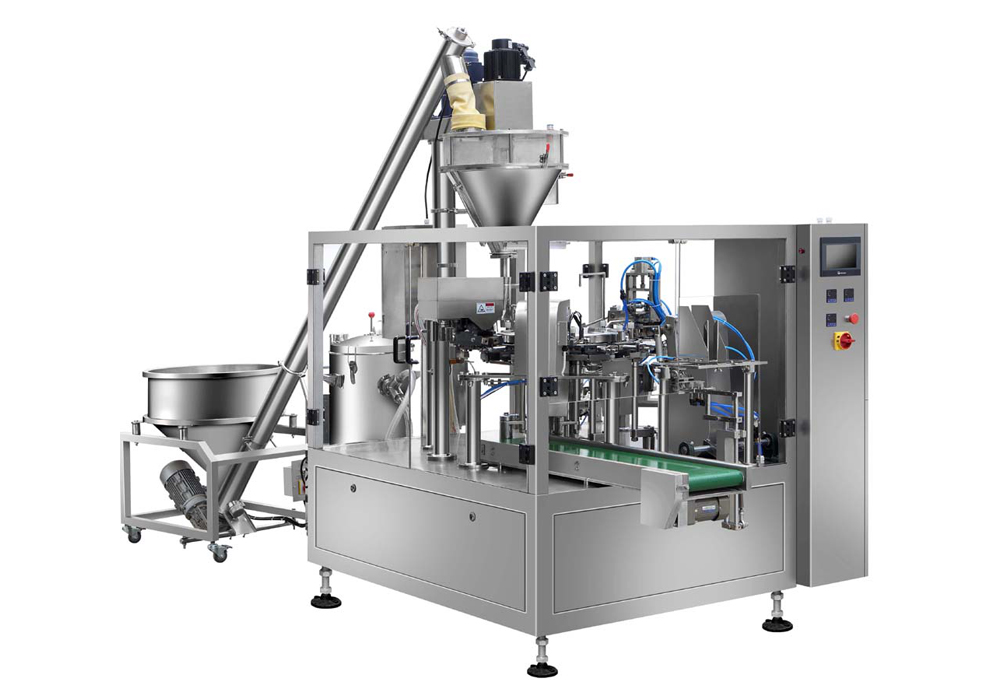
How does the NDP-300 optimize coffee powder weighing precision?
The NDP-300 uses an integrated PLC system to bridge the gap between high speed and coffee powder weighing precision. You benefit from a closed-loop system where the weighing sensor talks directly to the filling head. This allows the machine to make micro-adjustments to the auger speed if the ambient humidity changes the powder density.
What is the benefit of PLC control?
The Programmable Logic Controller acts as the brain of the operation, managing every millisecond of the cycle.
It stores “recipes” for different roast levels.
It monitors sensor data in real-time.
Here is the thing: the PLC can identify a weight trend and correct it before it becomes an error.
Can it handle flat-bottom pouches?
The NDP-300 is specifically designed for complex bag shapes that require precise timing for bottom opening. Ensuring the bag is fully open before filling prevents powder from spilling and affecting the final weight.
Key Takeaway: Advanced automation like the NDP-300 removes human error and environment-induced drift from the weighing process.
Machine Feature
Advantage
Precision Result
PLC Integration
Real-time monitoring
Automatic weight correction
Recipe Memory
Quick changeovers
Consistent settings for every roast
Pouch Vibrator
Settles powder
Prevents seal contamination
The NDP-300 represents the pinnacle of combining complex bag formats with meticulous dosing accuracy.
Can load cells improve coffee powder weighing precision?
Yes, high-sensitivity load cells provide the final layer of verification needed to maintain coffee powder weighing precision at the highest levels. You cannot rely on volume alone because coffee density fluctuates based on the roast date and oil content. Load cells measure the actual mass, ensuring that every bag meets your strict ±1g requirement regardless of external factors.
How do load cells work in packaging?
These sensors convert the physical force of the coffee’s weight into a precise electrical signal for the computer.
They filter out machine vibrations through digital signal processing.
They provide instantaneous data for the feedback loop.
Wait, there is more: modern load cells are rugged enough to withstand washdown environments.
Why is tare weight important?
The machine must account for the weight of the bag material itself before calculating the net weight of the coffee. Automatic taring ensures that variations in pouch weight do not lead to errors in the powder dose.
Key Takeaway: Mass-based weighing via load cells is the only way to guarantee accuracy when product density is inconsistent.
Sensor Spec
Performance
Benefit
Response Time
<50ms
Supports high-speed cycling
Accuracy
±0.1g
Exceeds standard industry needs
Vibration Filter
Integrated
Clean signals despite motor noise
Load cells act as the “truth” in your packaging line, verifying that every bag is perfect.
Is speed a barrier to coffee powder weighing precision?
Speed and accuracy are traditionally at odds, but modern high-speed machines overcome this through multi-stage filling to maintain coffee powder weighing precision. You do not have to sacrifice throughput for quality if your machine uses a “bulk and dribble” method. This involves dropping the majority of the product at high speed and finishing the last gram with a slow, precise pulse.
How does the multi-stage process work?
By splitting the fill cycle, you get the best of both worlds: high volume and surgical accuracy.
Stage 1: High-speed auger rotation for 90% of the volume.
Stage 2: Precision pulse for the final 10%.
Make no mistake: this is the secret to packing 60 bags per minute with ±1g accuracy.
What role does the conveyor play?
The transition from the filling station to the sealing station must be perfectly smooth to prevent spillage. Any powder lost during movement results in a lighter final bag and a messy seal.
Key Takeaway: Intelligent filling algorithms allow machines to move fast without losing control of the dosing volume.
Speed Level
Dosing Method
Precision Level
Low Speed
Continuous
Very High (±0.2g)
High Speed
Bulk only
Medium (±2.0g)
Optimized
Bulk + Dribble
High (±0.8g)
Balancing mechanical speed with electronic feedback is the hallmark of a high-performance packaging line.
How to maintain coffee powder weighing precision daily?
Daily calibration and cleaning are the non-negotiable pillars for maintaining coffee powder weighing precision over the life of your equipment. You need to treat your packaging machine like a precision instrument rather than a piece of heavy iron. Dust buildup on the auger or the weighing sensor will slowly degrade your accuracy if left unchecked.
What does a daily check include?
Operators should perform a quick verification at the start of every shift to ensure the sensors are zeroed.
Check the auger screw for signs of oil buildup.
Test the load cell with a certified calibration weight.
You see, five minutes of morning maintenance can save hours of rework later.
Why is cleaning the auger critical?
Coffee oils can become sticky, causing powder to cling to the screw threads and release inconsistently. A clean auger ensures that the volume of powder moved in every rotation remains exactly the same.
Key Takeaway: Consistency in maintenance leads to consistency in weight; never skip the daily cleaning cycle.
Maintenance Task
Frequency
Impact
Sensor Zeroing
Every Shift
Prevents weight drift
Auger Wipe-down
Weekly
Ensures smooth powder flow
Deep Calibration
Monthly
Maintains long-term ROI
Proper care ensures your machine performs as well on year five as it did on day one.
What tech drives drip bag coffee powder weighing precision?
Drip coffee packaging requires ultra-fine dosing, often moving from a ±1g target down to ±0.1g to maintain drip coffee bag weighing precision. You are dealing with very small total weights, usually between 8g and 12g, so even a tiny error is a huge percentage of the total. Following a specialized guide to drip coffee bag production is essential for mastering this niche.
How does micro-dosing work?
Micro-dosing uses specialized small-diameter augers that move minute amounts of powder per rotation.
Smaller augers provide higher resolution for small weights.
Ultrasonic sealing is often used to keep the powder away from the edges.
Simply put, smaller doses require more delicate mechanical handling.
Why is nitrogen flushing involved?
While nitrogen doesn’t directly affect weight, it prevents the powder from clumping by reducing humidity inside the bag. This kept the powder “free-flowing,” which is critical for consistent dosing speed.
Key Takeaway: Drip bag production demands a higher level of precision due to the low mass of the finished product.
Bag Type
Weight Range
Target Precision
Standard 250g
245g – 255g
±1.0g
Drip Bag 10g
9.9g – 10.1g
±0.1g
Bulk 1kg
998g – 1002g
±2.0g
As the package size decreases, the technical difficulty of maintaining accuracy increases exponentially.
Is volumetric dosing better for weighing precision?

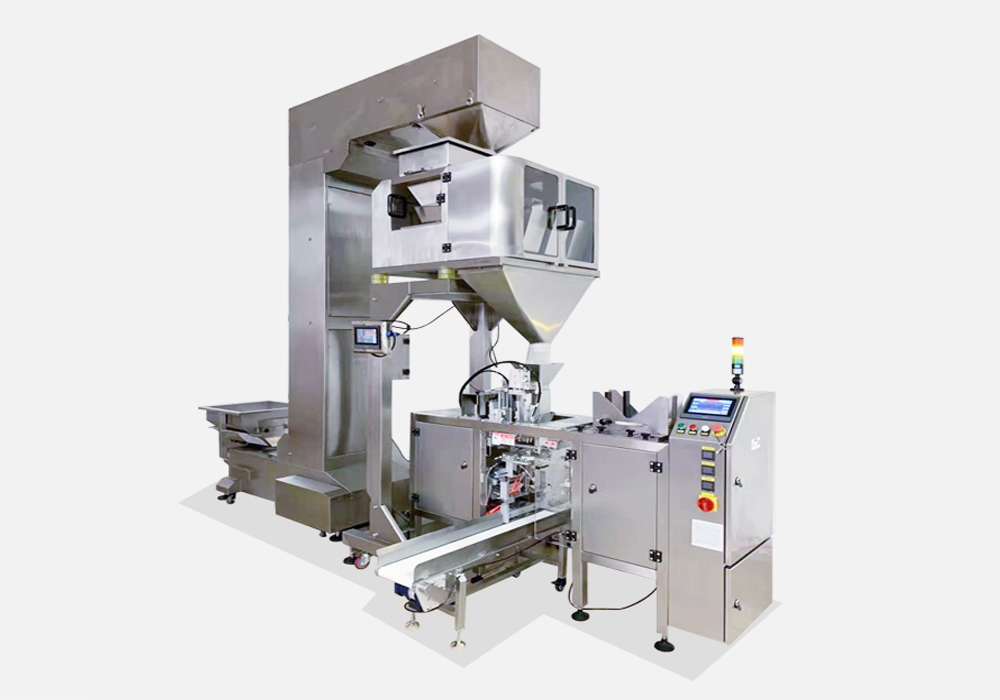
Volumetric dosing can be faster for certain products, but it generally offers less coffee powder weighing precision than auger-based systems. You should choose volumetric cups only if your coffee grind is extremely uniform and your production environment has perfectly controlled humidity. For most roasters, the density changes in the coffee powder make volumetric filling too risky for high-end applications.
When should you use volumetric cups?
Volumetric systems are excellent for low-cost, high-speed applications where a ±3g margin is acceptable.
They are simpler to maintain mechanically.
They are cheaper to purchase initially.
Bottom line: they lack the “intelligence” to adjust for density changes.
Why is the auger the industry standard?
Augers provide a physical barrier between the hopper and the bag, preventing the “drift” that occurs with cup fillers. The ability to pulse a servo motor for a fraction of a second gives you a level of control that cups simply cannot match.
Key Takeaway: While faster for some, volumetric filling cannot compete with augers for high-value coffee precision.
Feature
Volumetric Cup
Servo Auger
Accuracy
±2-3%
±0.5-1%
Adjustment
Manual/Slower
Digital/Instant
Best For
Consistent density
All coffee types
The digital control of an auger makes it the superior choice for modern, data-driven coffee facilities.
Why trust NewideaPack for coffee powder weighing precision?

With over 18 years of manufacturing experience, NewideaPack has developed the specific engineering expertise needed to guarantee coffee powder weighing precision for global brands. You are not just buying a machine; you are investing in a partnership with engineers who understand the physics of coffee. We customize every auger and hopper to match your specific roast profiles and packaging materials.
What sets our engineering apart?
Our machines use top-tier components like Delta PLCs and high-sensitivity sensors from world-class suppliers.
We offer custom-designed agitation systems for oily powders.
Our machines are built with food-grade stainless steel for durability.
Simply put, we focus on the details that lead to long-term reliability.
How do we support sustainable goals?
We lead the market in adapting our high-precision systems for compostable and recyclable films. We ensure that going green doesn’t mean you have to sacrifice the accuracy or speed of your production line.
Key Takeaway: Experience and specialized customization are the keys to achieving consistent packaging results at scale.
Service
Benefit
Outcome
Custom Engineering
Perfect fit for your product
Optimized throughput
Tech Support
Rapid troubleshooting
Minimized downtime
Material Testing
Film compatibility check
Guaranteed seal integrity
Trusting a specialist like NewideaPack ensures your production line remains a competitive advantage for your brand.
FAQ
Can I achieve ±1g accuracy with whole beans on an auger? No, augers are designed specifically for powders. For whole beans, you should use a multi-head weigher to avoid crushing the product and ensure accuracy.
What’s the best way to handle oily dark roasts? Direct judgment: Use an independent agitation motor in your hopper. This prevents the oily powder from sticking to the sides and ensures a consistent flow into the auger.
How do I adjust for humidity changes? Yes, you can adjust the “rotations” setting on your PLC. As humidity increases and powder gets heavier, you may need slightly fewer rotations to hit the same target weight.
Can I pack different weights on the same NDP-300? Yes, the system allows you to save multiple “recipes.” You can switch from 250g to 500g bags by simply selecting the new profile on the touchscreen.
How do I know if my load cell is failing? Direct judgment: Monitor the “weight drift” over a shift. If the machine consistently misses its target despite calibration, the sensor may be damaged or dirty.
Conclusion
Achieving ±1g precision in high-speed coffee powder packaging is a requirement for any roaster looking to maximize ROI and maintain brand standards. By combining servo-driven augers, sensitive load cells, and intelligent PLC control, you can eliminate product waste and focus on growth. Whether you are using traditional foils or innovative compostable materials, the right technology ensures your weights are always spot-on.
Sales Pitch Component
If you are ready to eliminate product giveaway and upgrade your production line
Contact us today to speak with a packaging expert. Let NewideaPack help you find the perfect balance between speed and precision for your coffee business.