Nitrogen Flushing for Coffee Beans: The Ultimate Guide to MAP Packaging
2025年10月17日 by newideapack
Modified Atmosphere Packaging (MAP) is a specialized preservation technique that replaces the oxygen inside a package with a protective gas like nitrogen to prevent food spoilage and maintain flavor integrity. You have likely experienced the frustration of opening a fresh bag of specialty roast only to find the complex fruity and floral aromas have vanished into a flat, stale disappointment. This rapid degradation happens because oxygen is the silent killer of quality, turning your premium harvest into a bitter, oily commodity within just two weeks of roasting. To solve this, Nitrogen flushing for coffee beans provides a high-tech protective shield that locks in peak flavor and extends freshness for up to six months or more.
Nitrogen flushing for coffee beans is an industrial process where ambient oxygen is purged from the bag and replaced with high-purity, food-grade nitrogen gas immediately before the final seal. This technique is the global gold standard for roasters who want to ensure their product tastes exactly the same in a customer’s kitchen as it did in the cupping room. New Idea Pack utilizes this technology to create a stable environment that pauses the aging process of the bean.
Why Use Nitrogen Instead of Regular Air?
Nitrogen is used because it is an inert, tasteless, and odorless gas that does not react with delicate coffee oils or volatile aromatic compounds. Unlike oxygen, which triggers the oxidation process and turns oils rancid, nitrogen creates a physical barrier that keeps the beans in a state of suspended animation.
Nitrogen is 100% food-safe and naturally occurring in our atmosphere.
It displaces moisture and oxygen simultaneously to prevent mold growth.
The gas provides a pressurized cushion to protect beans during transit.
It is a highly cost-effective solution for high-volume commercial production.
But that is not all.
Is This Only for Whole Bean Coffee?
While highly effective for whole beans, this process is arguably even more critical for ground coffee due to the increased surface area exposed to air. Ground coffee can lose its peak flavor in a matter of hours without protection, but MAP technology allows it to thrive for months.
Feature
Ambient Air Packaging
Nitrogen Flushing (MAP)
Gas Composition
21% Oxygen / 78% Nitrogen
<3% Oxygen / >97% Nitrogen
Oxidation Rate
Extremely High
Negligible
Aroma Retention
2-3 Weeks
6-12 Months
Flavor Profile
Rapidly Bitters
Remains Sweet and Clear
The data confirms that removing oxygen is the only way to maintain the complex chemical profile of specialty coffee over time.
Key Takeaway: Adopting nitrogen flushing ensures your beans maintain their specialty-grade profile from the production facility to the consumer’s cup.
How Does MAP Extend Coffee Shelf Life?
Modified Atmosphere Packaging (MAP) extends the shelf life of your product by significantly slowing down the chemical reactions between the coffee’s volatile oils and the external environment. Nitrogen flushing for coffee beans allows you to hit the “pause” button on the natural aging process, ensuring that the beans do not reach their stale point prematurely. By maintaining a controlled atmosphere, you can achieve a storage window that was previously impossible with traditional sealing methods.
Can It Really Triple Your Storage Time?
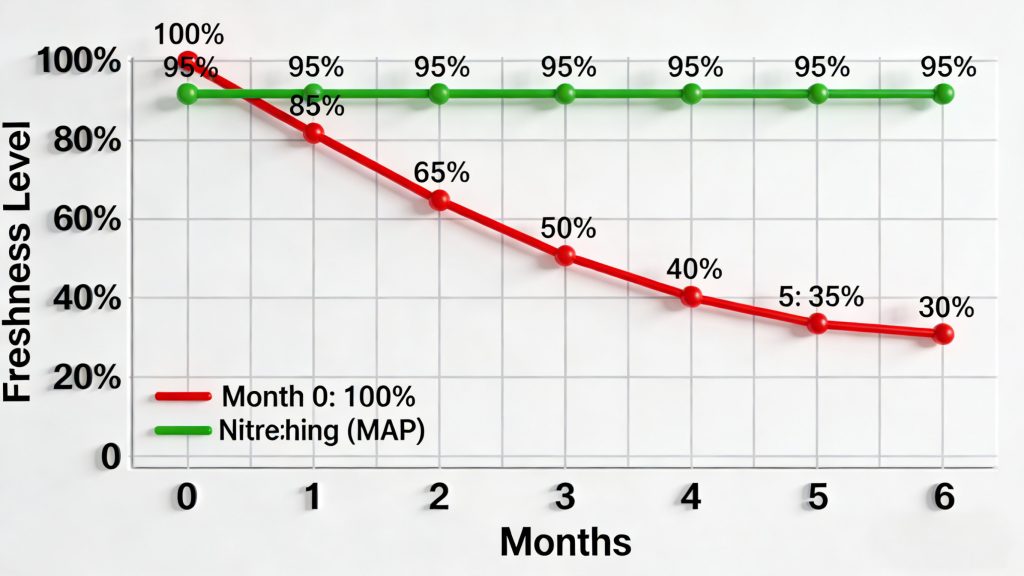
Yes, using nitrogen can often triple or even quadruple the viable retail life of your product compared to standard bag sealing without gas injection. While untreated beans start losing their “sweet spot” after just 14 days, MAP-protected beans can easily remain vibrant and aromatic for 180 days or more.
Prevents lipid rancidity in oily dark roasted beans.
Maintains the structural integrity of the cellular bean walls.
Reduces the speed of carbon dioxide loss over time.
Facilitates much longer international shipping and distribution routes.
Think about this for a second.
How Does Packaging Material Impact Shelf Life?
The shelf life extension depends heavily on using high-barrier films that prevent nitrogen from leaking out and oxygen from seeping back in. You must utilize materials like Mylar, aluminum-foil laminates, or specialized metalized films to maintain the internal atmosphere over long durations.
Storage Method
Typical Freshness Window
Quality Degradation Level
Open Bin Storage
3-5 Days
Total Aroma Loss
Standard Heat Seal
2-3 Weeks
Heavy Flavor Flattening
Nitrogen Flush MAP
6-12 Months
Minimal Sensory Change
This comparison highlights why atmospheric control is the foundational requirement for scaling a coffee brand globally.
Key Takeaway: Using MAP allows you to manage inventory more effectively and reach distant markets without sacrificing your brand’s reputation for premium quality.
Why Is Low Residual Oxygen So Essential?
Achieving low residual oxygen levels is critical because even a 1% increase in oxygen concentration can accelerate the staling process by nearly 10% in most food products. Nitrogen flushing for coffee beans is the only reliable way to hit these aggressive quality targets consistently at a high production scale. Professionals aim for oxygen levels below 3%, though many specialty roasters now demand levels as low as 0.5% for their premium single-origin lines.
What Happens Above the 5% Oxygen Threshold?
If the oxygen levels in your bag exceed the 5% threshold, the coffee’s delicate oils will rapidly oxidize and create unpleasant “off” flavors. At these levels, the benefits of your expensive roasting process and high-quality green beans are essentially neutralized within days of packaging.
Oxidation destroys the delicate floral notes of light roasts.
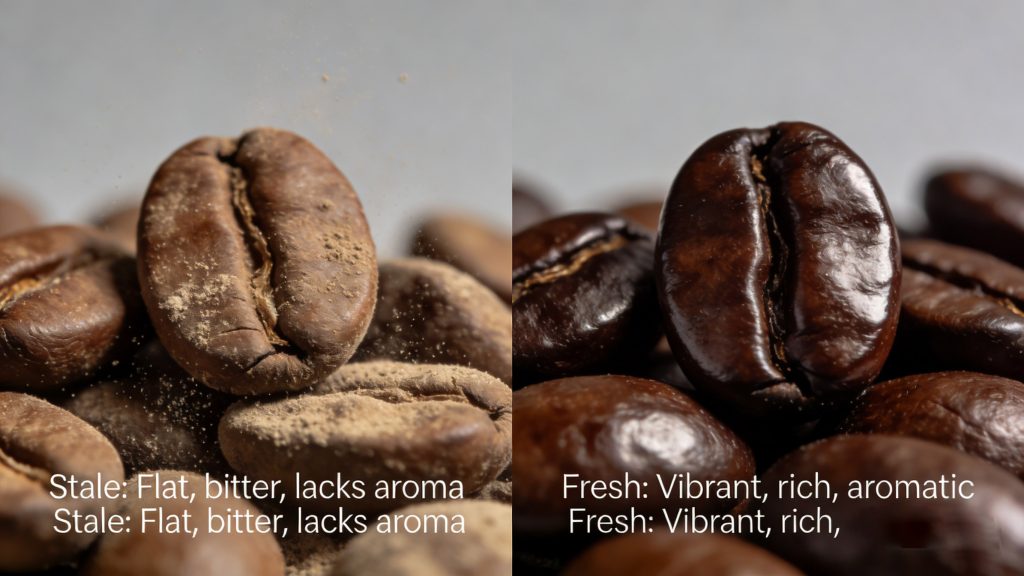
It causes the beans to lose their glossy appearance and look dull.
Essential aroma molecules are lost to the headspace of the bag.
Rancid oils can lead to a metallic or “old cardboard” aftertaste.
Here is the kicker.
How Does the Flush Process Achieve These Targets?
The machinery injects nitrogen at specific pressures into the bottom of the bag, which forces the lighter oxygen molecules upward and out before the seal is crimped. This “bottom-up” displacement ensures that the entire headspace is saturated with inert gas rather than ambient air.
Oxygen (O2) Level
Impact on Coffee Freshness
Best Use Case
Above 5%
Rapid staling within 14 days
Local quick-sale only
2.0% – 3.0%
Standard industry freshness standard
National retail distribution
Below 1.0%
Elite flavor lock for long-term storage
Global export and e-commerce
Maintaining these strict thresholds is the difference between a one-time buyer and a loyal, long-term subscriber.
Key Takeaway: Monitoring your residual oxygen levels ensures every bag you ship meets the highest quality standards in the specialty coffee industry.
How Does Nitrogen Protect Coffee Aroma?
Nitrogen protects coffee aroma by preventing the volatile organic compounds (VOCs) from escaping the bean and reacting with the surrounding air. Nitrogen flushing for coffee beans is a vital step in “locking in” the specific roast profile you worked so hard to develop in the roaster. These VOCs are what give coffee its distinct smell, and once they are lost to oxidation, they cannot be recovered by the consumer.
Why Do Aromas Disappear So Quickly?
Aromas are highly volatile, meaning they want to evaporate and dissipate the moment the bean is roasted, especially if there is empty space in the package. Nitrogen fills that headspace and exerts a stable pressure that helps keep the aromatic oils inside the cellular structure of the roasted bean.
Retains the “bloom” potential of the coffee when brewed.
Keeps the dry fragrance intense, sweet, and pleasant for the user.
Protects the enzymatic acidity that defines light and medium roasts.
Ensures the “first crack” complexity remains intact throughout the shelf life.
It gets even better.
Does Nitrogen Change the Natural Taste?
No, nitrogen is completely inert and does not alter the flavor profile of the bean, unlike other gases that might interact with the coffee’s chemistry. It simply acts as a biological shield that lets the natural bean characteristics and roast notes shine through to the final cup.
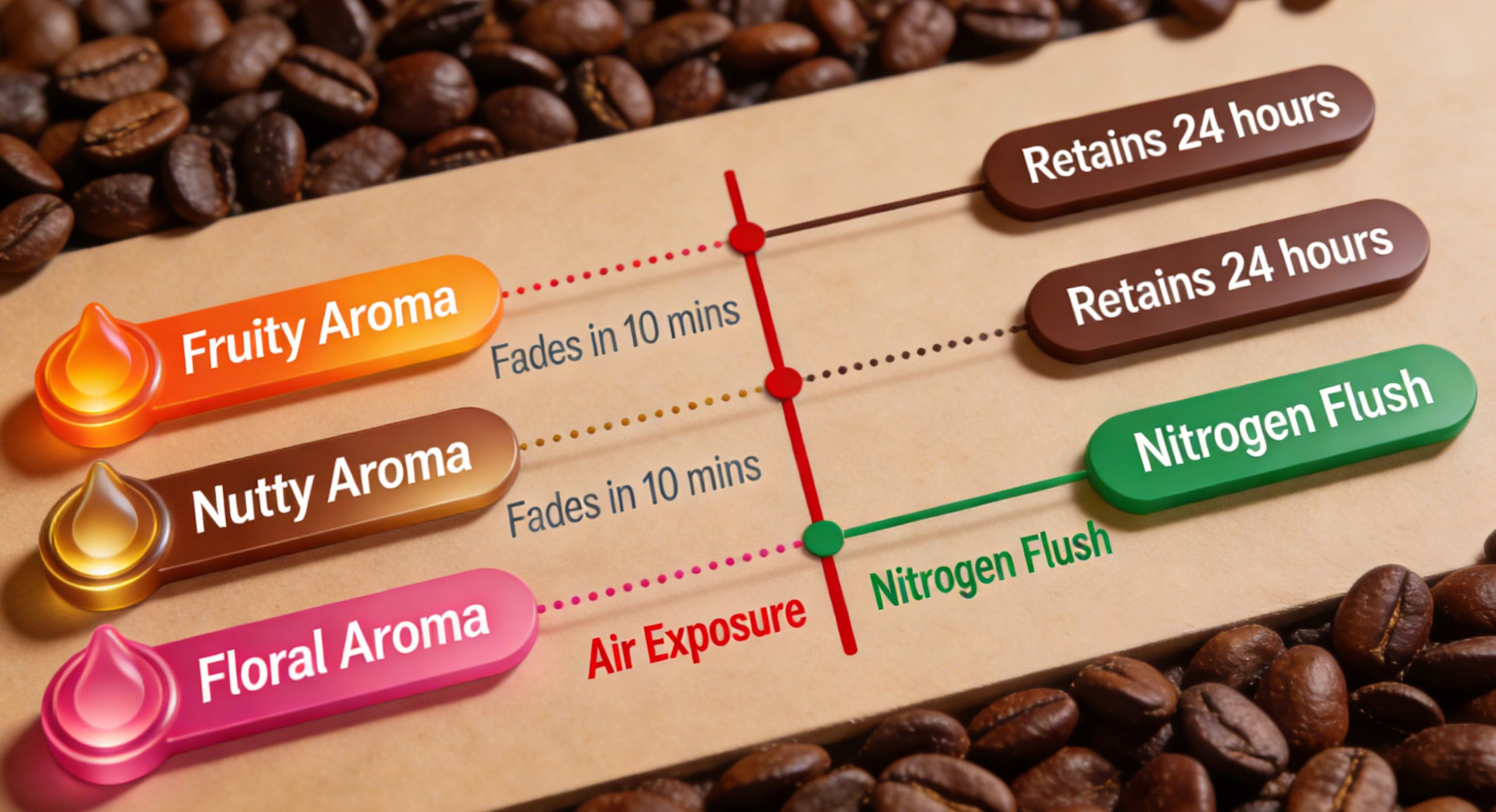
Aroma Component
Without Nitrogen (Air)
With Nitrogen (MAP)
Fruity Esters
Oxidize and disappear in 10 days
Stay fresh for 6+ months
Nutty Aromas
Turn bitter and flat very quickly
Remain sweet, clear, and distinct
Roast Volatiles
Dissipate into the package headspace
Locked securely in bean pores
Preserving the aromatic experience is what allows you to charge a premium for your hard-earned roasts in a crowded market.
Key Takeaway: Protecting volatiles with nitrogen ensures that the sensory experience of your coffee remains consistent months after the initial roasting date.
Which Machines Handle Nitrogen Flushing?
Advanced Vertical Form Fill Seal (VFFS) systems, like those from New Idea Pack, integrate Nitrogen flushing for coffee beans directly into the high-speed filling cycle. These machines are engineered to sync the gas pulse perfectly with the bean drop to ensure maximum oxygen displacement without wasting expensive gas. Utilizing an automated system allows for a level of precision that manual or semi-automatic methods simply cannot replicate.
Is Automatic Better Than Manual Flushing?
Automatic machines are significantly superior because they provide millisecond precision in gas timing, ensuring that every single bag achieves the same low residual oxygen target. Manual flushing is inherently inconsistent and often leads to “oxygen pockets” that ruin specific batches of coffee during storage.
High-speed production capabilities up to 60-90 bags per minute.
Integrated oxygen sensors for real-time monitoring of gas quality.
Seamless coordination with multi-head weighing scales for accuracy.
Compact footprints designed for modern, high-efficiency roasting facilities.
Believe it or not.
Can You Add MAP to Existing Production Lines?
Many modern systems, such as the drip bag ultrasonic packaging machine, come with nitrogen ports as a standard feature for easy integration. If you are growing your business, choosing a machine with built-in MAP capabilities is a critical future-proofing move for your production line.
Machine Type
MAP Compatibility
Production Speed Efficiency
Rotary Pouch Machine
High
Medium to High Speed
VFFS Machine
Excellent
Very High Speed
Manual Heat Sealer
Poor to None
Very Low Efficiency
Investing in the right automated hardware eliminates the guesswork and labor costs associated with manual nitrogen packaging.
Key Takeaway: Choosing professional MAP-enabled machinery from New Idea Pack allows you to scale your output while maintaining small-batch freshness levels.
Is Nitrogen Flushing Safe for Consumers?
Nitrogen flushing is 100% safe for consumers because the air we breathe on a daily basis is already composed of approximately 78% nitrogen. When used in Nitrogen flushing for coffee beans, the gas used is high-purity and food-grade, ensuring no contaminants are introduced to the product. It is a clean, natural preservation method that aligns perfectly with the standards of the modern specialty coffee industry.
Are There Any Chemical Residues Left Behind?
There are absolutely no chemical residues, additives, or preservatives left on the coffee because nitrogen is a natural element that does not bond with the beans. It is a physical preservation method rather than a chemical one, making it ideal for “clean label” and organic certified coffee brands.
FDA and EFSA approved for direct contact with food products.
Non-flammable, non-toxic, and completely safe for warehouse staff.
Used globally in everything from potato chips to pre-packaged salad bags.
Does not affect the “organic” or “fair trade” certification of your beans.
You can rest easy.
Shelf life comparison chart showing the benefits of nitrogen flushing for coffee beans vs standard air
Does It Affect the Caffeine Content?
Nitrogen has no impact on caffeine levels, antioxidants, or the overall nutritional value of the coffee, as it only prevents flavor degradation. Your customers will receive the same energy boost they expect, just with a much better, fresher taste profile.
Preservation Type
Consumer Safety Level
Synthetic Chemical Use
Nitrogen Flush
100% Safe
None (Natural Gas)
Vacuum Packing
100% Safe
None
Chemical Preservatives
Variable
Synthetic Additives
Safety and purity are core values for modern coffee drinkers, and nitrogen flushing aligns perfectly with those health-conscious expectations.
Key Takeaway: Using nitrogen allows you to preserve your coffee’s integrity without relying on artificial additives or complex, un-natural chemistry.
How Do Degassing Valves Improve MAP?
One-way degassing valves are the essential partner for Nitrogen flushing for coffee beans because they allow CO2 to escape without letting oxygen back into the bag. Freshly roasted coffee releases a massive amount of carbon dioxide, and without a valve, your nitrogen-flushed bag would eventually puff up and burst. By combining these two technologies, you create a one-way street for gases that ensures the internal atmosphere remains pure.
Why Can’t the Bag Stay Completely Sealed?
The bag cannot stay completely airtight because the internal pressure from degassing coffee can reach levels that compromise the side seals of the pouch. The valve acts as a pressure relief system that maintains the structural integrity of the package while keeping the nitrogen atmosphere intact.
Essential for whole bean coffee packaged immediately after roasting.
Prevents “bag bloat” and unsightly expansion on retail shelves.
Allows for the “sniff test” by consumers without exposing beans to air.
Works in tandem with nitrogen to create a one-way protective flow.
Here is the secret.
Do All Valves Work the Same Way?
High-quality valves use a precise rubber diaphragm and a tiny amount of food-grade silicone oil to create a perfect seal that only opens under pressure. Combining a premium valve with a professional New Idea Pack nitrogen flush is the secret sauce for professional-grade shelf stability.
Component
Role in Coffee Freshness
Strategic Synergy
Nitrogen Flush
Displaces Ambient Oxygen
Creates the initial safe zone
One-Way Valve
Releases Internal CO2
Protects the zone from pressure
High-Barrier Film
Blocks External Air
Maintains the zone long-term
This triple-threat approach is how the world’s most successful coffee roasters keep their products fresh during long-distance global shipping.
Key Takeaway: Never skip the valve when using nitrogen; the two technologies work together to manage internal pressure and gas purity simultaneously.
What Are the Industry Oxygen Standards?
The industry standard for nitrogen-flushed specialty coffee is to keep residual oxygen levels at or below 3% to ensure quality for up to six months. For specialized exports or long-term warehouse storage, the “gold standard” is often 1% or less, which is only achievable with high-end nitrogen flushing systems. Adhering to these standards is not just about quality; it is often a contractual requirement for large-scale grocery distributors.
What Is the “Danger Zone” for O2 Levels?
Oxygen levels above 5% are considered the “danger zone,” where staling becomes noticeable to the average consumer within just 14 to 21 days of roasting. If you are selling to supermarkets, they will often require proof that your packaging line stays consistently below these oxygen thresholds.
< 3.0%: Minimum requirement for high-end specialty retail.
< 1.0%: Required for global exports and premium coffee pods.
< 0.5%: The elite tier for ultra-premium, rare coffee roasts.
> 5.0%: Unacceptable for any product intended for long-term storage.
You might be wondering.
Is 0% Oxygen Level Possible?
While hitting absolute 0% is nearly impossible in a high-speed production environment, getting down to 0.1% is achievable with vacuum-assisted nitrogen flushing. For most commercial roasters, the cost-benefit sweet spot for quality and speed is between 0.5% and 1.5% residual oxygen.
Quality Tier
Target O2 Level
Global Market Suitability
Commodity Grade
5% – 10%
Local quick-sale markets only
Premium Grade
2% – 3%
Regional retail and Online sales
Specialty/Elite
Below 1%
Global shipping and Subscriptions
Adhering to these rigorous standards ensures that your brand remains competitive in a market that increasingly values long-term freshness and flavor.
Key Takeaway: Setting and meeting strict oxygen targets is the most effective way to guarantee a consistent, high-quality customer experience every time.
Can MAP Packaging Reduce Product Waste?
MAP packaging dramatically reduces product waste by preventing “stale-outs,” where coffee must be discarded because it sat on a shelf for too long. By extending the shelf life of your product, Nitrogen flushing for coffee beans allows roasters to produce larger batches and maintain a more flexible inventory. This reduction in waste directly translates to higher profit margins and a more sustainable business model for growing roasteries.
How Much Money Is Lost to Stale Coffee?
Roasters can lose up to 15% of their total inventory to staling if they rely on “just-in-time” roasting without the protection of nitrogen. Nitrogen flushing turns that lost revenue back into profit by giving you a 6-month buffer instead of a stressful 2-week deadline for sales.
Reduces the frequency of expensive, low-volume “rush” roasting sessions.
Lowers the carbon footprint by optimizing regional shipping logistics.
Minimizes customer returns and complaints due to “flat” or bitter flavor.
Allows for bulk buying of green beans with total inventory confidence.
It is a game changer.
Freshly roasted coffee bag being sealed with nitrogen flushing for coffee beans to preserve aroma.
Does It Help with Marketing Seasonal Roasts?
Yes, MAP technology allows you to offer seasonal or limited-edition roasts for a longer period, ensuring the last bag tastes as good as the first. This stability makes it significantly easier to manage marketing campaigns and holiday sales peaks without the fear of product expiration.
Waste Category
Standard Air Packaging
MAP Nitrogen Packaging
Shelf Spoilage
High (Loss after 2 weeks)
Very Low (Safe for 6 months)
Customer Returns
Frequent due to staling
Rare (Freshness is locked in)
Inventory Risk
High (Financial exposure)
Low (Stable asset management)
Reducing waste isn’t just good for your bottom line; it is a critical step toward a more sustainable and efficient roasting operation.
Key Takeaway: Nitrogen flushing is an essential investment in inventory security that pays dividends by virtually eliminating the costs associated with product spoilage.
How Can You Audit Your Packaging Line?
Auditing your packaging line involves regular testing with a headspace oxygen analyzer to ensure your nitrogen flushing is performing within the required specifications. A “set it and forget it” approach often leads to drifted gas levels and inconsistent quality, which can quietly erode your brand’s reputation for freshness. By implementing a rigorous audit schedule, you ensure that the technology you invested in is actually delivering the results you promised.
How Often Should You Perform Tests?
You should ideally test a bag at the start of every production shift and every time you change your packaging film variety or bean type. High-volume roasters often perform “random pull” tests every hour to ensure that nitrogen flow hasn’t been interrupted by equipment issues.
Check the nitrogen tank pressure levels every single day.
Calibrate your oxygen analyzer weekly to ensure measurement accuracy.
Inspect one-way valves for proper seating and seal integrity.
Record all residual oxygen readings in a permanent quality log.
Here is the bottom line.
What Should You Look for in a Leak?
If your oxygen levels are unexpectedly high, check for “micro-leaks” in the fin seal or the corners of the bag where the film is folded. Sometimes the issue isn’t the nitrogen flush itself, but a seal that isn’t strong enough or hot enough to hold the modified atmosphere.
Audit Step
Frequency
Operational Goal
O2 Headspace Test
Every Production Batch
Verify < 3% Residual Oxygen
Seal Integrity Test
Hourly Random Checks
Identify micro-leaks or weak spots
Gas Pressure Check
Start of Every Shift
Ensure consistent nitrogen flow
A rigorous audit process ensures that the machinery you purchased from New Idea Pack continues to perform at peak efficiency day after day.
Key Takeaway: Regular auditing transforms nitrogen flushing from a guessing game into a precise, scientific guarantee of consistent product quality.
Conclusion
Nitrogen flushing is the single most powerful tool for any roaster looking to maintain peak flavor and extend shelf life in a competitive global market. By mastering the balance of Modified Atmosphere Packaging and low residual oxygen, you ensure your customers experience the full potential of your roast every single time they open a bag. We have seen how this technology prevents waste, protects delicate aromas, and allows your business to scale across borders with total confidence in your product. If you are ready to stop losing profits to stale beans and start delivering uncompromising freshness, contact us today to find the perfect packaging solution for your facility. New Idea Pack is dedicated to helping you build a coffee brand that is synonymous with quality, one perfectly flushed bag at a time.
FAQ
Can I use nitrogen flushing for small home-roasting setups? No, it is typically only efficient and cost-effective for commercial roasters using automated packaging equipment. While small handheld flushers exist, they rarely achieve the consistent sub-3% oxygen levels required for professional shelf-life results.
What’s the best way to tell if a bag was nitrogen-flushed? Directly checking for a slightly pressurized, “puffy” feel to the bag combined with the presence of a one-way valve is the best indicator. Without nitrogen, a bag of fresh beans would either be vacuum-sealed (tight) or completely flat and prone to rapid oxidation.
How do I know if my nitrogen levels are dropping during a run? Yes, you must use a digital headspace oxygen analyzer to get an accurate, real-time reading from your production line. If your coffee starts losing its aroma earlier than expected, it is a clear sign that your residual oxygen is creeping above the 5% danger zone.
Can I flush bags without using a one-way valve? No, because freshly roasted coffee naturally emits CO2 that will cause the bag to expand and eventually burst if there is no escape route. The valve is the critical partner that allows the nitrogen to stay inside while letting the coffee “breathe” safely during the degassing phase.
How long does coffee stay fresh after the nitrogen-flushed bag is opened? Directly after opening, the nitrogen escapes and oxygen rushes in, meaning the coffee should be consumed within 7 to 10 days for peak flavor. Nitrogen flushing protects the coffee during long-term storage, but it cannot stop the oxidation process once the initial seal is broken.
Sales Pitch Component
If you are ready to stop losing profits to stale beans and start delivering uncompromising freshness
contact us today to find the perfect packaging solution for your facility.