Coffee Metal Detector: How to Ensure Zero-Defect Packaging
2026年1月17日 by newideapack
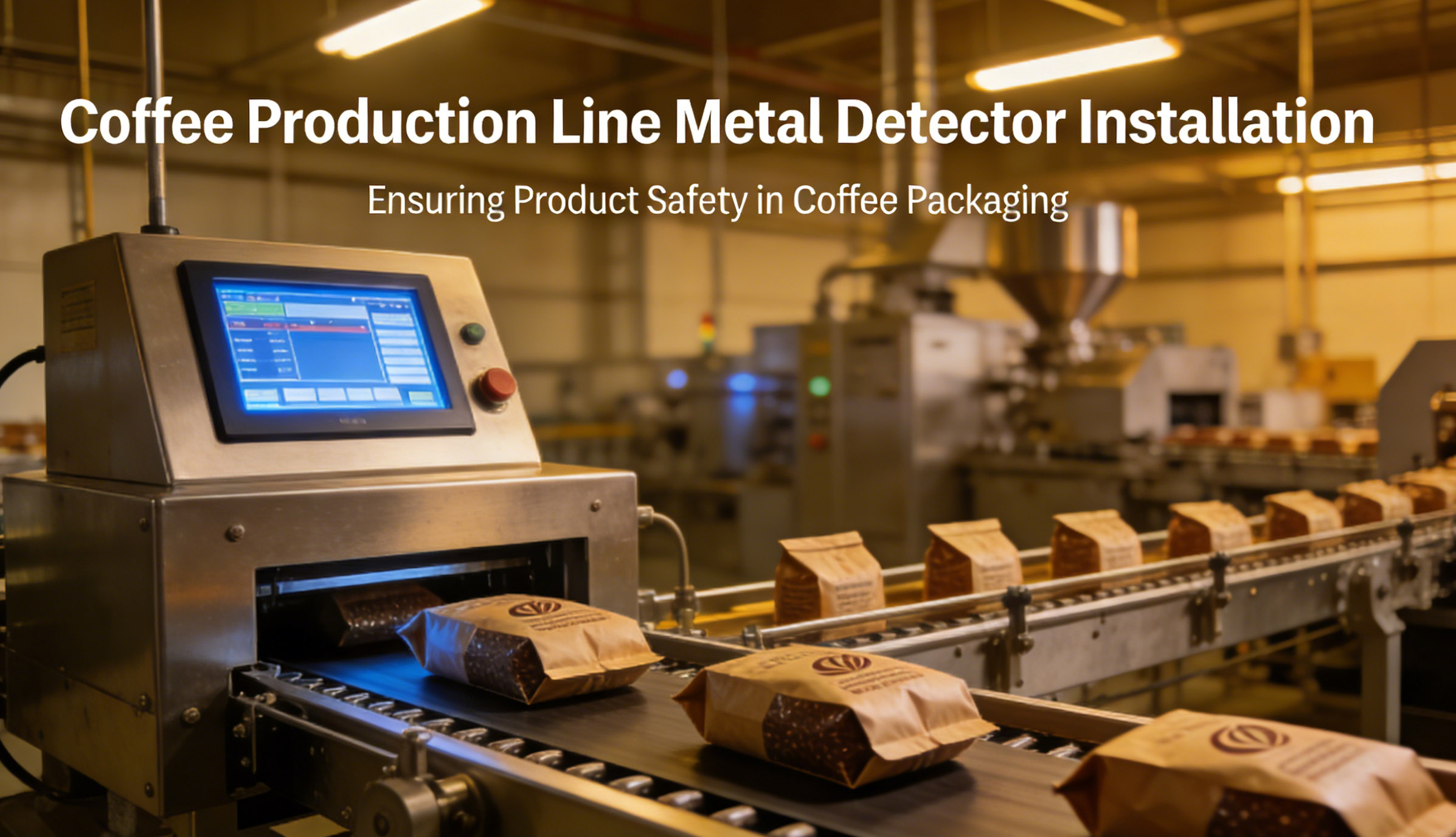
Integrating a metal detector into your coffee packaging line is the most effective way to eliminate physical contaminants and protect your brand reputation. Even the most meticulous roasting facility faces the risk of a loose bolt from a grinder or a wire shard from a bean sack finding its way into the final product. These metallic fragments are invisible to the eye but devastating once they reach the consumer’s cup. Imagine the fallout of a nationwide product recall or the permanent destruction of customer trust. To avoid these catastrophic scenarios, you need a high-precision Coffee metal detector that provides “zero tolerance” security for modern food safety compliance.
Coffee Metal Detector: How to Ensure Zero-Defect Packaging
Preventing Physical Hazards in Beans
Here is the reality: Contamination can happen at any stage, from the harvesting of raw cherries to the final grinding process. Whether it is a piece of mesh from a sieve or a fragment of transport machinery, these items must be removed.
Ferrous metals (iron/steel)
Non-ferrous metals (brass/copper)
Stainless steel shards
Broken equipment components
Ensuring HACCP and FDA Compliance
Maintaining compliance with HACCP and FDA regulations is mandatory for any commercial roaster today. A documented metal detection process serves as a Critical Control Point (CCP) during safety audits.
Key Takeaway A robust detection system acts as your first line of defense against litigation and equipment damage. By identifying contaminants early, you preserve both your machinery and your brand’s integrity.
Summary Table: Safety Compliance Essentials
Compliance Factor
Requirement
Benefit
HACCP
Critical Control Point
Systematic risk reduction
FDA/FSMA
Traceability & Prevention
Legal market access
Equipment Safety
0.5mm sensitivity
Reduced repair costs
Effective hazard prevention starts with understanding the specific risks in your production flow.
How Does a Coffee Metal Detector Work?
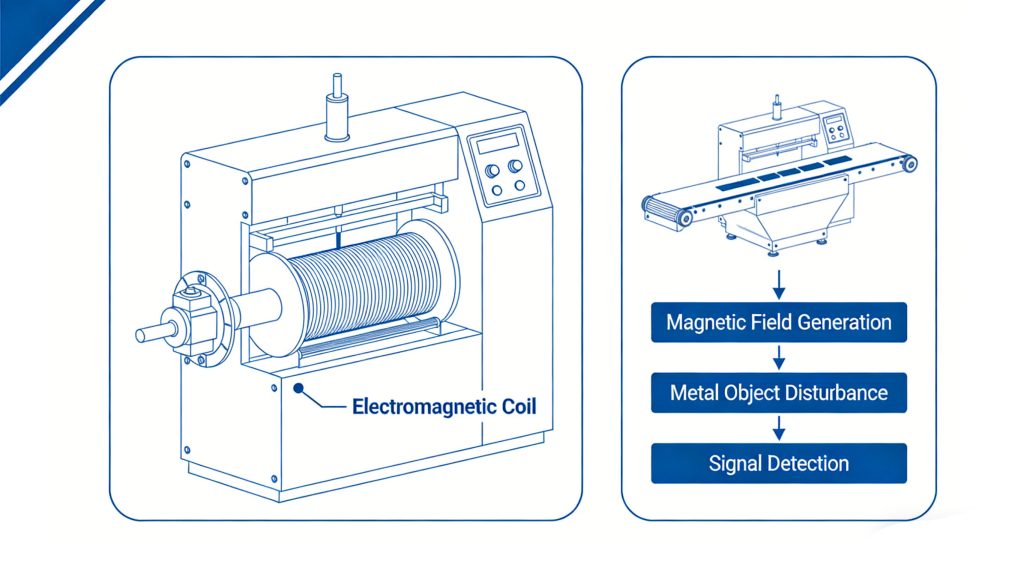
A coffee metal detector works by using high-frequency electromagnetic fields to identify disturbances caused by metallic objects passing through its aperture. When you integrate a coffee industry packaging machine, the detector precisely monitors the product flow for even the tiniest magnetic or conductive changes.
Detection of Ferrous and Non-Ferrous Metals
The system utilizes balanced coils to create a stable electromagnetic field. When a metal particle enters this field, it creates an imbalance that triggers an automatic rejection signal.
Ferrous: Highly magnetic and easiest to detect.
Non-Ferrous: Conductive but non-magnetic, like copper.
Stainless Steel: The most difficult due to low conductivity.
Overcoming the Product Effect in Coffee
Think about this: Coffee beans often contain moisture or minerals that can mimic a metal signal, a phenomenon known as the “product effect.” Modern systems use sophisticated software to filter out these “ghost” signals.
Key Takeaway Understanding the electromagnetic principles of your detector allows you to fine-tune sensitivity. This ensures that you catch real contaminants without suffering from constant false alarms.
Summary Table: Contaminant Detection Capabilities
Contaminant Type
Minimum Size
Detection Difficulty
Ferrous (Iron)
0.5 mm
Low
Non-Ferrous (Brass)
1.0 mm
Medium
Stainless Steel
1.5 mm
High
Advanced balanced coil technology is the backbone of reliable metal detection in dry granule applications.
Which Coffee Metal Detector Is Best?
The best coffee metal detector for your facility depends on whether you are processing whole beans or fine ground coffee. You must choose between gravity-fed units for free-falling product or conveyor-mounted systems for bagged goods.
Gravity-Fed vs. Conveyor Systems
Gravity-fed units are typically installed directly post-roaster or post-grinder to inspect bulk product. Conveyor systems are better suited for the final inspection of sealed bags to ensure no contamination occurred during packaging.
Gravity units use high-speed reject flaps.
Conveyor units use pushers or air blasts.
Gravity systems require less floor space.
Conveyors allow for final end-of-line QC.
Multi-Frequency Technology for Precision
But wait, there’s more. Multi-frequency technology allows the machine to scan at several different frequencies simultaneously. This maximizes the probability of detecting different metal types in varying bean densities.
Key Takeaway Selecting the right machine architecture ensures that your detection sensitivity matches your production speed. Don’t compromise on a “one size fits all” solution when specialized gravity units exist.
Summary Table: Machine Selection Guide
Machine Type
Best Use Case
Reject Method
Gravity-Fall
Bulk Ground/Beans
High-speed Flap
Conveyor
Sealed Bags/Pouches
Pusher/Belt Stop
Throat-Style
VFFS Integration
Signal to Bagger
Choosing the correct equipment type is the first step toward a seamless packaging integration.
Where to Place Your Coffee Metal Detector?
The ideal location for your coffee metal detector is at the final stage of packaging, just before the product is boxed for shipping. However, many experts suggest placing a secondary unit post-grinder to protect quad-seal bag packaging machines from damage caused by internal debris.
Critical Control Points in Roasting
You should identify the stages in your roasting process where metal introduction is most likely to occur. These are your Critical Control Points (CCPs), and they require dedicated monitoring equipment.
Raw bean intake (pre-roast)
Post-grinding (bulk powder)
Final bagging (pre-boxing)
Bulk bagging for 25kg sacks
Integration with VFFS Packaging Lines
The beauty of it is: Modern detectors can be mounted directly onto the forming tube of a Vertical Form Fill Seal (VFFS) machine. This “throat” integration saves space and ensures inspection happens at the very last second.
Key Takeaway Strategic placement minimizes the amount of product you have to waste if a contaminant is found. Catching metal before it reaches the bag is always more cost-effective than rejecting a sealed pouch.
Summary Table: Optimal Placement Strategy
Location
Purpose
Integration Type
Post-Roaster
Protect Grinder
Gravity-Fall
Post-Grinder
Protect Bagger
Throat-Style
End-of-Line
Final Quality Check
Conveyor
Correct placement ensures that your quality control is as efficient as it is effective.
Does a Coffee Metal Detector Use AI?
Yes, modern coffee metal detector systems use Artificial Intelligence to differentiate between actual metal and the “product effect” caused by the beans’ natural properties. This technology significantly reduces the number of false rejects that can eat into your profit margins.
AI Algorithms for Reduced False Rejects
AI-driven software learns the specific signal profile of your various roasts, whether they are oily dark roasts or dry light roasts. This allows the machine to ignore the background noise of the coffee itself.
Real-time signal analysis
Automated threshold adjustment
Pattern recognition for contaminants
Deep learning for new products
Self-Learning Capabilities for Bean Types
But that’s not all. Self-learning systems allow you to pass a “clean” sample through the machine several times. The AI then creates a digital “fingerprint” of the product to ensure total accuracy.
Key Takeaway AI is a game-changer for roasters who handle a wide variety of bean origins and roast levels. It eliminates the need for manual sensitivity tweaks every time you change a batch.
Summary Table: AI vs. Traditional Detection
Feature
Traditional Systems
AI-Powered Systems
False Alarms
Frequent (Product Effect)
Minimal (Filtered)
Setup Time
Manual Calibration
Auto-Learn (1-3 passes)
Accuracy
Fixed Threshold
Dynamic Adaptation
Embracing AI technology transforms your safety line from a bottleneck into a precision tool.
Can a Coffee Metal Detector Stop Recalls?
A coffee metal detector is the most reliable tool to prevent product recalls by identifying and removing contaminants before they ever leave your facility. When you utilize remote monitoring, you can even track every rejection in real-time to ensure no faulty product slips through.
Removing Contaminants Down to 0.5 mm
Modern units are sensitive enough to find microscopic shards that would otherwise go unnoticed during manual inspection. This level of precision is what keeps your brand off the FDA’s recall list.
Detects broken needle tips
Finds wire fragments from sacks
Identifies internal machine wear
Spots tiny aluminum foil slivers
Protecting Brand Reputation and Trust
The bottom line is: One viral social media post about a metal shard in your coffee can destroy years of brand building. A dedicated detection system is essentially an insurance policy for your public image.
Key Takeaway Prevention is always cheaper than a cure when it comes to food safety. Investing in a high-quality detector today prevents the million-dollar costs associated with a nationwide recall tomorrow.
Summary Table: Recall Risk Mitigation
Risk Factor
Without Detector
With Detector
Legal Liability
High Exposure
Documented Protection
Recall Costs
$1M+ Potential
Cost of Machine Only
Brand Image
Permanent Damage
“Quality Guaranteed” Status
Robust metal detection is the cornerstone of a “safety-first” brand culture.
Is a Coffee Metal Detector IoT-Ready?
Modern coffee metal detector units are fully IoT-ready, allowing you to monitor your production line’s safety performance from any smartphone or computer. This connectivity enables you to collect data on rejection rates and machine health without standing on the factory floor.
Real-Time Remote Monitoring via IoT
You can receive instant notifications if the machine detects a high frequency of contaminants in a specific batch. This allows your team to stop the line immediately and investigate the source of the problem.
Instant alert notifications
Cloud-based data logging
Performance analytics dashboards
Multi-site machine management
Predictive Maintenance and Uptime Alerts
Think about this: IoT systems can predict when your detector’s sensors might need cleaning or calibration. This proactive approach ensures that your line never goes down unexpectedly due to a sensor failure.
Key Takeaway Connected machines turn raw data into actionable insights for your management team. Being IoT-ready means your quality control department can operate with 100% transparency.
Summary Table: IoT Connectivity Benefits
IoT Feature
Operational Impact
User Benefit
Remote Logging
Digital Safety Records
Easier Audits
Live Alerts
Immediate Intervention
Reduced Waste
Predictive Maintenance
Scheduled Servicing
Higher Uptime
Smart connectivity ensures your safety standards are maintained regardless of where you are.
How to Calibrate a Coffee Metal Detector?
To calibrate a coffee metal detector, you must use certified test pieces to ensure the machine triggers a reject signal at the required sensitivity levels. When running a high-speed drip bag machine, regular calibration checks are essential to maintain a continuous safety audit trail.
Setting Sensitivity for Dry Products
The sensitivity must be set low enough to ignore the beans but high enough to catch a 1.0mm stainless steel sphere. You should perform this check at the start of every shift and after every product changeover.
Use Fe, Non-Fe, and SS test sticks
Document the time of every test
Verify the reject mechanism works
Test both middle and edges of the aperture
Managing Stainless Steel Detection Levels
Here is the kicker: Stainless steel is non-magnetic and poorly conductive, making it the “final boss” of metal detection. Proper calibration requires specific “SS-only” modes to ensure these dangerous shards don’t pass through.
Key Takeaway Calibration is not a “set it and forget it” task; it is a daily commitment to safety. Regular testing with certified materials is the only way to prove your machine is actually working.
Summary Table: Calibration Standards
Test Piece
Size Goal
Frequency
Ferrous (Fe)
0.8 mm
Every 4 Hours
Non-Ferrous (NFe)
1.0 mm
Every 4 Hours
Stainless Steel (SS)
1.5 mm
Every 4 Hours
A disciplined calibration schedule is the difference between a safety tool and a placebo.
Why Choose a Newidea Coffee Metal Detector?
Choosing a newideapack coffee metal detector ensures that your safety equipment is perfectly synchronized with your packaging machinery. Our systems are designed to integrate seamlessly with both bulk bagging lines and high-speed retail packaging units.
Seamless Integration with Quad-Seal Lines
Our detectors are modular, meaning you can easily retrofit them into your existing conveyor setups or VFFS frames. We focus on “plug-and-play” connectivity to minimize your installation downtime.
Compact footprint for tight spaces
Industrial-grade 304 stainless steel
IP66 waterproof rating for cleaning
Intuitive touch-screen interface
Support for Drip Bag and Bulk Bagging
But wait, there’s more. Whether you are packing 10g drip bags or 25kg bulk sacks, our detection range covers every aperture size. We provide the specific reject mechanisms required for each unique packaging format.
Key Takeaway Working with a single-source provider like newideapack simplifies your support and maintenance. We ensure that your metal detector and bagger “speak the same language” for total line control.
Summary Table: Newidea System Advantages
Feature
Newidea Benefit
Competitor Standard
Integration
Native Sync with Newidea
Third-party Hassles
Durability
Full 304 SS Construction
Partial Plastic Parts
Software
AI-Self Learning Included
Extra Cost Upgrade
A unified packaging and detection line reduces complexity and increases overall reliability.
What Is a Coffee Metal Detector ROI?
The ROI of a coffee metal detector is measured by the thousands of dollars saved in prevented recalls and the extended lifespan of your grinding equipment. By integrating auxiliary packaging machinery, you create a high-efficiency environment where safety pays for itself.
Reducing Product Waste from False Alarms
Traditional detectors often reject perfectly good coffee because they can’t handle the product effect. Modern AI-driven systems ensure that only truly contaminated product is tossed, saving you thousands in raw material costs.
Lower scrap rates
Less downtime for “ghost” alarms
Reduced labor for manual re-checking
Optimized throughput speeds
Long-term Savings in Food Safety Compliance
The reality is simple: The cost of a single lawsuit or a major retailer’s fine can exceed the price of ten metal detectors. By automating your safety checks, you also reduce the labor costs associated with manual quality control.
Key Takeaway View your metal detector not as a cost, but as a profit-protection tool. Over a five-year period, the reduction in waste and risk makes the initial investment remarkably small.
Summary Table: Financial Impact Analysis
Expense Category
Cost Without Detector
Cost With Detector
Annual Waste
High (Manual Error)
Low (AI Precision)
Maintenance
High (Grinder Damage)
Low (Protected)
Compliance
Risk of Fines
Audit-Ready
The financial benefits of automated detection extend far beyond simple safety—they drive bottom-line profitability.
Conclusion
Integrating a coffee metal detector is no longer optional in the modern specialty coffee market; it is a fundamental pillar of food safety and operational excellence. By combining AI-powered detection, IoT remote monitoring, and seamless line integration, you can guarantee a contaminant-free product that satisfies both regulators and customers.
At newideapack, we are dedicated to helping roasters transition to smart, automated packaging solutions that eliminate risk and maximize efficiency.
FAQ
Can I detect metal in coffee packed in aluminum foil bags? Yes, but you need a specialized “ferrous-in-foil” detector or an X-ray system. Standard electromagnetic detectors will “see” the aluminum bag as a massive contaminant, so you must use technology that ignores non-ferrous conductive packaging.
How do I know if my detector is calibrated correctly? You must pass certified test pieces (Fe, Non-Fe, and Stainless Steel) through the center of the aperture. If the machine triggers the reject mechanism for all three test pieces, your calibration is considered valid for that shift.
Can a coffee metal detector handle both beans and ground coffee? Absolutely, although the configuration usually changes. Gravity-fall units are superior for bulk beans and ground powder, while conveyor systems are better for inspecting the final sealed retail pouches.
What is the “product effect” in dark roasted coffee? This refers to the signal generated by the product itself, which can be high in dark roasts due to moisture or surface oils. AI-driven detectors are designed to learn and ignore this specific signal to prevent false rejections.
How often should I clean the detector aperture? You should wipe down the sensor area at least once per shift. Dust buildup, especially from ground coffee, can interfere with the electromagnetic field and reduce detection sensitivity over time.
Sales Pitch Component
If you are ready to secure your production line and protect your brand from the hidden dangers of metallic contaminants
Contact us today to discuss a custom integration strategy. Our vision is a “zero-defect” future for every roastery, where technology and craftsmanship work in perfect harmony.